


"We Already Have a CRM." Why That Isn't a Pricing Strategy.
21 August 2026




Shilpa Joshi
Director Business StrategyShilpa Joshi is Director – Business Strategy at Applexus Lavendel. She has over 21 years of experience in Pricing Transformation, Business Analysis, and Business Strategy Leadership,...
Nobody questions the ERP. It runs the business, and everyone accepts it. The CRM gets a little more scrutiny, but it usually survives - it owns the customer relationship, so its place is understood. Pricing software is where the questioning really starts. "My CRM already handles customer data and deals," the argument goes. "Why do I need a separate, dedicated tool just for pricing?"
I've watched pricing directors struggle to answer that question in their own organizations - not because there isn't an answer, but because the answer lives one layer deeper than most conversations go. So let me make the case plainly, because it's one of the most important and least understood distinctions in enterprise software.
CRM is tactical. Pricing is strategic.
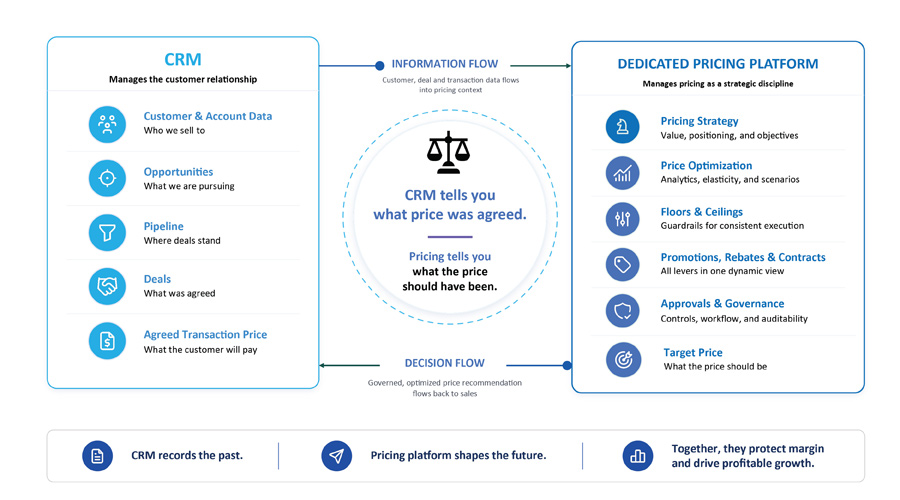
The case for pricing software doesn’t depend on the CRM being bad at anything. It depends on the two answering different questions – and a business needing both answers. A CRM is very good at what it does: managing the tactical side of the customer relationship - deals, contacts, pipeline, the mechanics of a sale as it happens. What it doesn't do is construct strategy. And pricing, done properly, is a strategic discipline before it is ever a transactional one.
Think about what happens when a product is launched. The marketing and product teams study its value - what it delivers to the customer, where it should sit in the market, whether it's premium or standard - and they arrive at a deliberate price. Then that product travels downstream to sales, and something quietly goes wrong. Sales teams carry different targets and different incentives, so the careful distinction between "premium" and "standard" starts to dilute. The people who set the strategy lose line of sight into what's happening at the point of sale. The people at the point of sale never fully saw the strategy in the first place. That gap - between intent and execution - is exactly where margin leaks.
A dedicated pricing platform closes that gap. It carries the strategy all the way down: it hands the sales team the floors and ceilings, the value story they're meant to be telling, and the guardrails on how far they can flex - so the strategy set at the top actually survives the journey to the front line. It also puts governance around the exceptions. Deals will always need to bend, and the point isn’t to stop that – it’s to make sure that when a deviation happens, it’s a well-informed one that somebody owned and approved, rather than a quiet erosion nobody logged.
“A CRM tells you what price was agreed. A pricing platform tells you what the price should have been – and gets you there, consistently, before the deal closes. They’re complementary, not redundant.”
- Shilpa Joshi, Director - Business Strategy, Applexus Lavendel
The whole picture, on a dynamic basis
Here's a scenario I've seen play out many times. A salesperson walks into a negotiation today. What they may not know is that yesterday, somewhere else in the organization, a rebate was already committed to that same customer. Or that a promotional calendar and a set of contractual prices are running in parallel for that account right now. Without a holistic, live view of promotions, contracts, and rebates all at once, that salesperson is negotiating in the dark - and every blind negotiation is money left on the table.
Could you assemble that picture from a CRM? In theory, yes. But the data is scattered across the system, and pulling it together is only half the battle - the other half is maintaining it, continuously, as conditions change. Pricing by its nature is dynamic. Market conditions move, competitors move, costs move. The real question isn't whether you can reconstruct the picture once. It's how quickly you can react when the picture changes.
"It can be built" is not the same as "it should be built"
This is where the conversation almost always lands: build versus buy. And on the surface, a capable analyst with historical data and a BI tool can produce something. They can crunch closed deals, spot patterns, and estimate a discount band. So why not just build it in-house on top of the CRM?
Two reasons.
First, expertise. When a team of analysts builds a pricing model as a side project, how confident can anyone really be in it? With limited pricing experience, mistakes are easy to make - and harder still, nobody is positioned to notice where the mistakes are. A dedicated platform built by pricing specialists carries decades of cross-industry pattern recognition inside it. It doesn't just crunch numbers; it knows what to look for, because it was built by people who price for a living.
Second, pace. Pricing is too dynamic to freeze into a fixed set of use cases. You cannot say, "here are the ten scenarios I'll build for, and they'll hold for the next five years" - because war, supply shocks, competitor moves, and cost swings will invent scenarios you never imagined. A dedicated vendor pours continuous R&D into exactly this problem. An in-house build, however clever at launch, falls a little further behind with every release you don't ship. And if a competitor is running a dedicated platform while you're not, you're likely already being outpaced on margin without even seeing it.
There's a useful test here: an in-house tool makes sense when your use case is narrow and stable. It's the wrong bet when the use case is broad, high-stakes, and constantly moving. Pricing is firmly the second kind.
"The danger with a home-built model isn't that it's wrong. It's that no one is positioned to notice where it's wrong - so you never learn how much money you're leaving on the table." - Shilpa Joshi, Director - Business Strategy, Applexus Lavendel
Where the real difference shows up
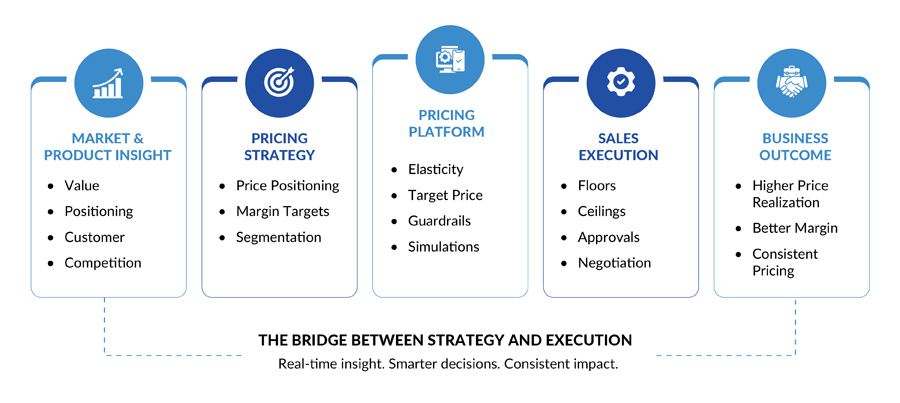
The gap between "directed" analytics and raw analytics is the whole point. A BI dashboard gives you information. A dedicated pricing platform gives you direction - and increasingly, that direction is powered by genuine science, not just number-crunching.
For example consider list price optimization. Blindly raising a price is rarely a good idea, because an increase in price can mean a decrease in volume - that's elasticity, and it's not something a CRM sets out to calculate. A proper pricing platform studies your history, factors in elasticity, and lets the business layer its own constraints on top – the kind of rules that matter enormously in a business running thousands of SKUs across standard and premium lines: I need a 10% gap between my standard and premium lines; I need to sit at a defined margin above a named competitor, or above the average of five. From those inputs it generates a target price you can actually defend. And when conditions shift, simulations let you vary an input and see the effect on revenue, margin, and volume almost immediately.
And to be clear about AI's role: the point of these tools has never been to replace human judgment. The trust ultimately sits with the pricing experts. What makes a platform like Pricefx different is precisely that it is built by pricing experts - so the science serves the strategy rather than substituting for it. That's a differentiator that doesn't fade as the technology evolves. If anything, it deepens.
The bottom line
None of this makes the CRM the wrong tool. It makes it the wrong tool for this particular job. Pricing is not a feature of the customer relationship – it is a discipline of its own, strategic, dynamic, and unforgiving of guesswork. The two work best side by side: the CRM carries the relationship and the transaction, the pricing platform decides what that transaction should be worth. So when people ask why they need dedicated pricing software on top of a perfectly good CRM, the honest answer isn’t that their CRM is failing. It’s that it was never asked the pricing question in the first place – and in the gap, they’re almost certainly leaving money on the table already. They just can’t see how much.
Wondering how much margin your current setup is quietly leaving behind? Let's start a conversation.