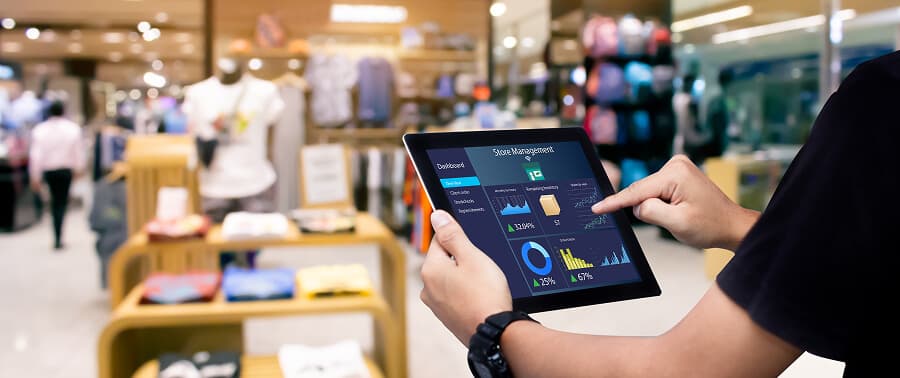


Why UK Retailers Can’t Afford to Wait on Cloud ERP
31 March 2026



Kevin Butcher
Vice President - New Business SalesKevin Butcher is the Vice President of New Business Sales at Absoft, an Applexus company. A results-driven leader with deep expertise in enterprise software, Kevin brings...
A recent industry survey found that over 60% of UK retailers still run core operations on ERP systems that are more than a decade old. Many of these platforms pre-date omnichannel commerce, real-time inventory expectations, and the wave of regulatory, cost and supply chain pressures that have reshaped UK retail over the past decade. They weren’t built for the way retail works today — and the gap between what these systems can do and what the business needs from them is widening every quarter.
This isn’t a technology problem in the abstract. It shows up in day-to-day operations: finance teams spending days reconciling data that should flow automatically; buying teams making decisions on last week’s stock figures; warehouse managers juggling disconnected systems across online and store fulfilment. The symptoms vary, but the root cause is the same — the systems at the centre of the business haven’t kept pace with how the business actually runs.
The Quiet Cost of Standing Still
Legacy ERP rarely fails dramatically. It degrades gradually. Reports take longer to pull. Integrations require more manual intervention. Workarounds become so embedded that no one remembers the original process. And in many UK retailers, the 'ERP' at the centre is not a single integrated platform at all, but a patchwork of ageing point solutions, in-house tools and spreadsheets that make it even harder to change quickly.
Meanwhile, the business moves on. New channels launch. Store formats evolve. Fulfilment models shift. And the ERP that once sat comfortably at the centre of operations starts to become the thing that holds them back. Finance can’t close books fast enough. Inventory visibility is always a step behind. Supply chain decisions rely on spreadsheets because the system can’t deliver what’s needed in real time.
Because the system still technically works, the case for change gets deferred --- quarter after quarter, year after year. The hidden cost is the inability to innovate at pace, with teams spending time keeping disconnected systems running instead of responding to new customer expectations or testing new propositions.
The cost isn't just operational. UK retailers are also absorbing rising cost burdens across trade compliance, taxation, supply chain disruption and workforce retention. Many legacy and home-grown systems can only handle these changes through manual workarounds or custom development, so every regulatory or process change becomes a project and every workaround adds risk.
What’s Changed — And Why It Matters Now
Three forces are converging that make 2026 a pivotal year for UK retail ERP decisions --- and modern, integrated cloud platforms are now making it simpler, cheaper and faster to become a lean, agile, responsive business.
Omnichannel is no longer optional
Most retailers recognise that customers move between online, mobile, and physical stores seamlessly. The real barrier is the perceived cost and complexity of stitching these channels together on an integrated platform. Enterprise cloud ERP reduces that barrier by providing a single, integrated foundation for stock, pricing, orders and fulfilment across every touchpoint.
Regulatory complexity keeps growing
Trade compliance, data protection, ESG reporting and industry-specific regulations all add cost and administrative overhead. Modern cloud ERP platforms embed regulatory updates and controls into the core processes, so compliance becomes an automated, background outcome rather than a quarterly fire drill.
Legacy system end-of-life is accelerating
Major ERP vendors are sunsetting on-premise products. SAP’s ECC maintenance deadline, Oracle’s legacy platform roadmap, and Sage’s product transitions all point in the same direction: the platforms many UK retailers rely on today will not be supported indefinitely. The question isn’t whether to move - it’s when, and on what terms.
A Faster Path to Cloud ERP
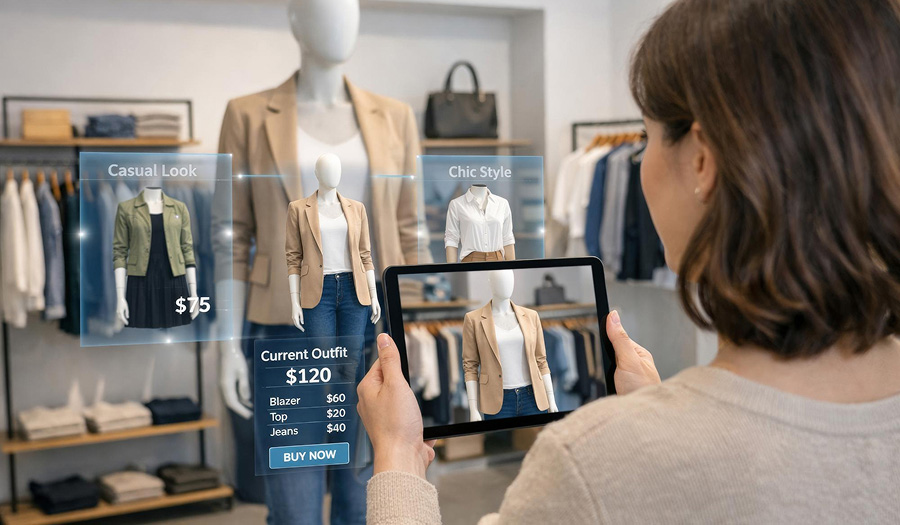
Historically, the biggest barrier to cloud ERP adoption hasn’t been the technology itself - it’s been the implementation. Traditional ERP programmes stretch across 18 to 24 months, consuming executive attention, straining budgets, and forcing the business to run on systems that are already under strain while the new platform is being built.
That's changing. Pre-configured, industry-specific cloud ERP solutions are compressing that timeline dramatically. Instead of building from scratch, retailers can now adopt platforms where core retail processes - finance, procurement, sales, inventory, warehouse management - are already configured and tested. It also creates a natural opportunity to revisit platform strategy: consolidating a patchwork of ageing, previously 'best-of-breed' or niche systems onto a future-proof cloud foundation.
The result is a fundamentally different adoption experience: go-live in weeks rather than years, with predictable costs and a clear scope. For UK retailers who’ve been deferring the ERP conversation because of the perceived scale of the project, this changes the equation.
Where the Impact Shows Up
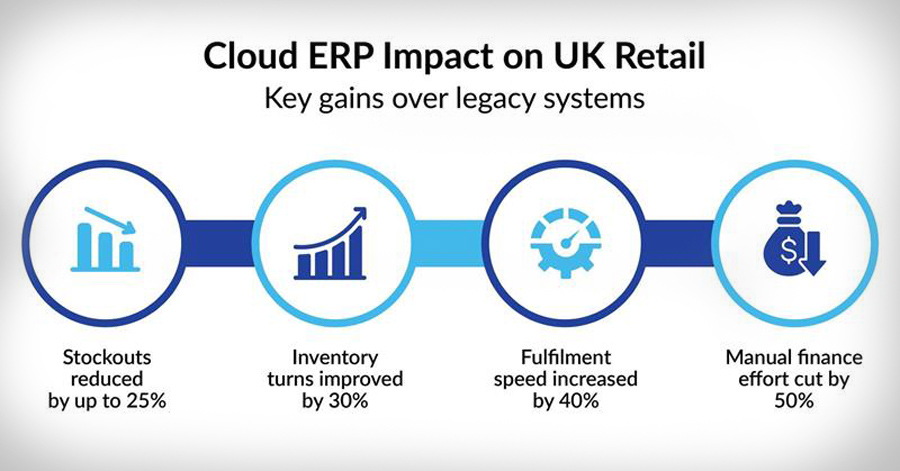
Retailers who have made the shift to cloud ERP consistently report improvements across the same areas that legacy systems struggle with most. Across recent UK retail implementations, the pattern is clear:
- Stockouts reduced by up to 25% - with real-time inventory visibility across all channels, replenishment happens before gaps appear on shelves or online
- Inventory turns improved by 30% - AI-driven demand forecasting and automated replenishment reduce overstock while keeping availability high
- Fulfilment speed increased by 40% - unified order management across online, store, and warehouse channels eliminates handoff delays
- Manual finance effort cut by 50% - automated reconciliation, real-time reporting, and embedded controls replace spreadsheet-driven month-end processes
These aren’t theoretical projections. They reflect what happens when retail operations run on a system designed for how retail actually works today - connected, real-time, and built to scale.
The Window Is Narrowing
Every quarter spent on a legacy platform is a quarter where compliance costs compound, integration complexity grows, and the distance between where the business is and where it needs to be gets harder to close. The retailers who act now will have modern, cloud-native operations in place before the next wave of regulatory change, the next peak trading season, or the next competitive disruption.
The question for UK retail leaders isn’t whether cloud ERP is the right direction. It’s whether they can afford to wait another year to get there.
Ready to Explore Cloud ERP for Your Retail Business?
RetailEdge by Applexus is an SAP QPPS-qualified cloud ERP solution built specifically for UK retail and fashion businesses --- with go-live from 16 weeks and a fixed, predictable investment, so you can become a fast, lean, agile retailer without a multi-year transformation programme.
Learn more about RetailEdge to understand how to address your unique challenges.
Schedule a RetailEdge Consultation to assess your needs and plan your path forward.