

One Size Doesn't Fit All: Lessons from Two Fashion S/4HANA Migrations
05 June 2026




Richard Pascoe
Vice President - Consulting ServicesRichard Pascoe is the VP – Consulting Services at Applexus Technologies, UK. He leads Applexus’ Consulting Services in the UK and Europe, bringing over 38 years...
With SAP ending mainstream maintenance for AFS and ECC in 2027, roughly 300+ fashion companies running AFS face a defining technology decision. The industry consensus says the path forward is SAP S/4HANA Fashion. The debate, however, is how to get there and what business value SAP S/4 Fashion delivers.
SAP’s own messaging pushes clean core - strip out customizations, adopt standard processes, move to the cloud. It’s a compelling vision on paper. But for fashion businesses that have spent years shaping AFS around their unique supply chains, seasonal buying cycles, and size-color-style complexities, a rigid clean-core approach can feel like replacing a tailored fit with something standardized.
At Applexus, we’ve migrated fashion companies at both ends of this spectrum - and everywhere in between. The lesson? There’s no single right answer. The right migration strategy depends on your business, not on a vendor’s roadmap.
“Forcing a one-size-fits-all approach on fashion companies — an industry that literally exists to offer choice — is the wrong play.”
Why the AFS-to-S/4 migration is uniquely hard
Most S/4HANA migrations follow a familiar playbook: brownfield (system conversion) or greenfield (reimplementation). But AFS customers don’t have that luxury. The underlying data models and architecture of AFS are fundamentally different from S/4HANA Fashion. SAP itself acknowledges that a traditional brownfield conversion from AFS is not feasible.
That leaves fashion companies with a stark choice: pursue a full greenfield reimplementation or find a more selective path forward. But greenfield’s real cost is rarely the technology — it’s organizational change management (OCM): redesigning processes, retraining users, driving adoption. Timelines of six months to two years leave little margin as the 2027 deadline approaches.
And here’s what makes it harder: AFS systems are among the most heavily customized in the SAP universe. Fashion businesses rarely customize without a strong operational reason. They do it because standard SAP couldn’t handle seasonal allocation logic, complex grid structures, vendor compliance workflows, stock segmentation, and protection, among others. These are not things you casually switch off or replace with a vanilla solution - they are deeply embedded in operational processes.

A third way: selective transition with CeleRITE
The traditional migration conversation offers two choices: greenfield (start over) or brownfield (convert everything). For AFS customers, brownfield isn’t even an option due to architectural incompatibility. And greenfield, while clean, is often costly and time-consuming for complex environments.
CeleRITE, Applexus’s AI-powered migration platform, enables a selective transition approach that breaks this binary. It lets fashion companies choose which customizations to carry forward and which to retire - based on business value. CeleRITE automates the assessment, identification, and migration of custom code, delivering up to 40% savings on migration costs and timelines versus a pure greenfield approach.
This means a brand pursuing clean core can retire obsolete custom code with confidence. And a brand needing continuity can retain critical customizations without full reimplementation. The same platform. The same methodology. Two different outcomes — each aligned to business needs.
Two migrations. Two philosophies. One platform.
We recently completed AFS-to-S/4HANA Fashion migrations for two very different global fashion brands. Together, they illustrate why the industry needs a more nuanced conversation about clean core versus customization.
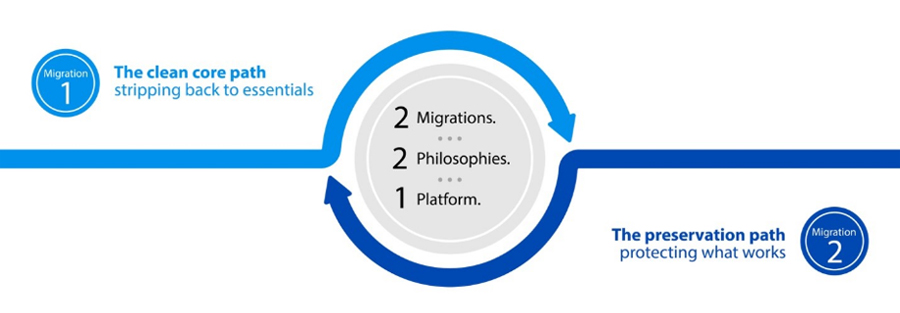
The clean core path: stripping back to essentials
Our first client, a global lifestyle brand with operations across multiple continents, made a strategic decision: use the S/4HANA migration as an opportunity to modernize and simplify. Their AFS environment had accumulated years of custom transactions, but the business was ready for change.
Working with Applexus, they adopted a fit-to-standard approach. We used CeleRITE, our AI-powered selective transition platform, to assess their entire custom landscape and systematically retire unnecessary enhancements. By the end, they had reduced their custom footprint to roughly 27 active enhancements - a fraction of their original AFS configuration. Much of their custom code was workarounds for AFS limitations that S/4HANA Fashion now handles natively.
The results were significant: the project was completed in just 8 months, the client gained a future-proof, upgrade-friendly system, and they were positioned to take advantage of S/4HANA’s embedded AI and analytics capabilities from day one.
Clean core worked well here - because the business was ready for it, and the customizations removed were either obsolete or replaceable with S/4HANA Fashion capabilities.
The preservation path: protecting what works
Our second client, a heritage American fashion brand with deeply integrated, complex supply chain processes, had a completely different set of priorities. They had invested heavily in their AFS customizations over the years: roughly 800 RICEF objects covering everything from order management to vendor collaboration. For this client, many of those customizations represented years of operational refinement and business differentiation - not simply technical debt. They were competitive advantages. Their RICEFs encoded wholesale allocation and vendor logic specific to their distribution model — not generic functionality.
For them, a clean core approach would have meant ripping out systems that powered competitive differentiation and absorbing significant change management overhead. The business explicitly wanted to minimize disruption and preserve the processes their teams relied on daily.
Using CeleRITE’s selective migration capabilities, Applexus carried those customizations forward into S/4HANA Fashion intact. The migration preserved business continuity, kept the change management burden manageable, and still delivered the client onto a modern, ERP platform. Clean core wasn’t the goal. Business continuity was.
The real insight: clean core is a spectrum, not a switch
“The right question isn’t ‘how do we get to clean core?’ but ‘what does our business need to compete?’
SAP pushes clean core because it aligns with its cloud roadmap - standardized systems are easier to maintain, upgrade, and move to public cloud. That’s a valid engineering argument. But it’s not the only valid business argument.
The reality is that clean core exists on a continuum. Some companies are ready to standardize because parts of their custom code no longer deliver value. Others have built proprietary processes that are central to how they compete. Asking them to abandon those processes in the name of architectural purity isn’t transformation - it risks losing business value.
Where BTP changes the equation
At the same time, clean core does not mean eliminating customization altogether. Many fashion companies can maintain a clean digital core while extending differentiated processes through SAP BTP and modern extension frameworks. The goal is not customization versus clean core; it is identifying where standardization creates efficiency and where differentiation creates business value.
What we’ve learned from doing this work on both ends of the spectrum is that the right approach is the one that starts with the business question, not the technology question. Not “how do we get to clean core?” but “what does our business need to operate, compete, and grow on a modern platform?”
Six questions every AFS customer should be asking
Before defining a migration approach, leadership teams should align around a few key questions:
What business benefits do we realize by upgrading to S/4HANA Fashion Vertical?
Which customizations are genuinely driving value, and which are legacy baggage?
What’s the change management cost of stripping out customizations versus carrying them forward?
Is our migration partner offering a flexible approach, or pushing a single ideology?
Can we see proof of migrations at both ends of the spectrum — clean core and customization-heavy?
What does our path to AI, analytics, and continuous innovation look like regardless of where we land on the spectrum?
The bottom line
The AFS-to-S/4HANA migration is not a technology upgrade. It’s a strategic business decision that will define how a fashion company operates for the next decade.
The right partner won’t tell you clean core is the only answer. They won’t say preserving everything is the only answer either. They’ll help you find the right balance — and get you there faster, with less risk, and with your competitive advantages intact.
At Applexus, we’ve proven we can do both. And everything in between. .
Ready to explore your AFS-to-S/4HANA options?
Applexus has migrated fashion companies across the full clean core spectrum. Talk to our fashion practice team to assess your custom landscape and find the approach that fits your business. Visit applexus.com or contact us to schedule an AFS migration assessment.