



Driving Better Forecast Accuracy with AI-Led Supply Chain
Applexus built an AI-led forecasting engine on Databricks to turn demand signals into smarter decisions across inventory, capacity, equipment, and procurement.
One trusted demand signal powering every planning decision.
For a leading industrial gases producer, forecasting had become the constraint on the entire supply chain. There was no trusted demand number: figures were assembled analyst by analyst on individual assumptions, and by the time a revised number reached planners, demand had already moved. Applexus paired SAP process knowledge with supply chain and data science expertise to build forecasting around how the business actually plans. Forecasts now drive weekly inventory, capacity, equipment, and procurement decisions. Using the Applexus Momentum Framework, the data and AI foundation was modernized, positioning the business to move from optimized operations toward AI-driven autonomy as agentic capabilities mature within its workflows and guardrails.
 Enlarge
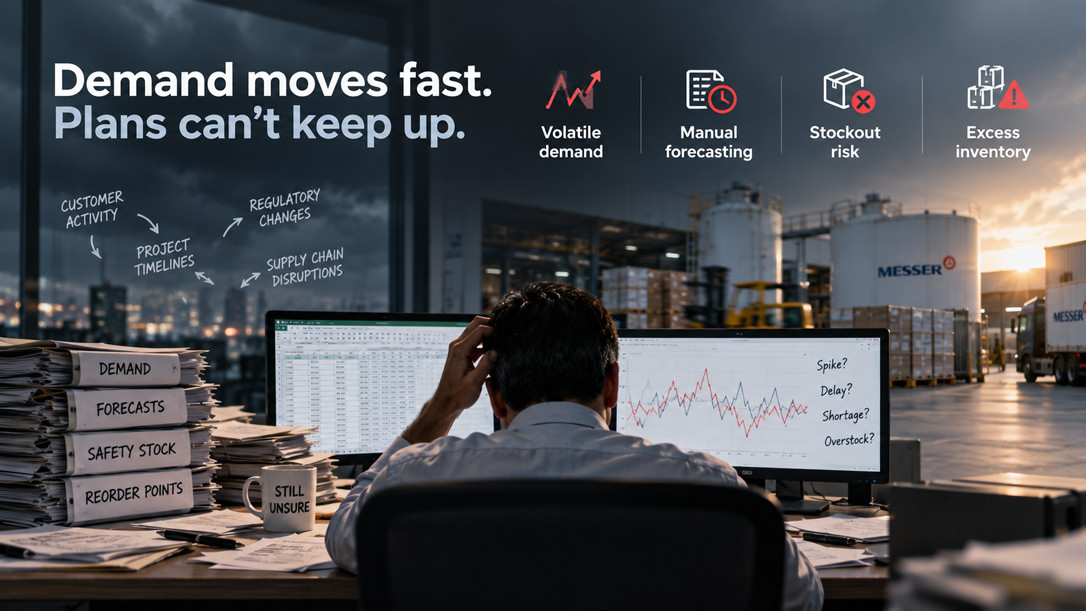
Planning a Supply Chain Where Demand Changes Faster Than Plans
Demand shifts with customer activity, project timelines, regulatory changes, and supply chain disruptions. Manual planning could not keep pace, with consequences in four areas:
- Demand volatility. Demand changed faster than plans could be revised, making manual planning unreliable.
- Manual forecasting. Planning depended on spreadsheets, static reorder points, and manually maintained safety stock calculations.
- Stockout risk. Insufficient inventory created the risk of production delays and disrupted customer operations.
- Excess inventory. Excess stock increased working capital and warehousing costs without improving responsiveness.
Build an AI-Driven Forecasting Foundation for Smarter Supply Chain Planning
Establish a trusted demand forecasting capability to serve as the planning foundation across multiple supply chain functions:
- Improve forecast accuracy using machine learning.
- Replace spreadsheet-based forecasting with AI-driven predictions.
- Enable dynamic inventory planning.
- Improve production capacity planning.
- Optimize equipment deployment.
- Improve procurement planning through forward-looking demand intelligence.
One Forecast Engine Supporting Multiple Supply Chain Decisions
Most forecasting projects stop at a model. Applexus made an architectural call instead: rather than separate models per planning function, build one forecasting engine as the trusted upstream intelligence source, then encode each downstream planning decision on top of it. Applexus modeled the client's own planning logic, safety stock policy, equipment logistics, and material yield conversions, so forecasts arrive as decisions planners can act on rather than numbers they must interpret. Each phase was validated on production data before further capabilities were introduced. The engine supports six connected capabilities:
- AI demand forecasting engine. Centralized demand predictions by product and planning period.
- Inventory optimization. Dynamic safety stock calculations together with stockout and overstock risk scoring.
- Capacity planning. Forecast-driven production utilization, with bottlenecks identified early.
- Equipment planning. Demand translated into cylinder and equipment requirements across locations.
- Procurement planning. Finished-product demand converted into raw material requirements via yield and conversion models.
- Progressive machine learning maturity. From statistical baselines to advanced ensemble models, with production monitoring and MLOps.
 Enlarge
A Governed Data Foundation Feeding AI Forecasting
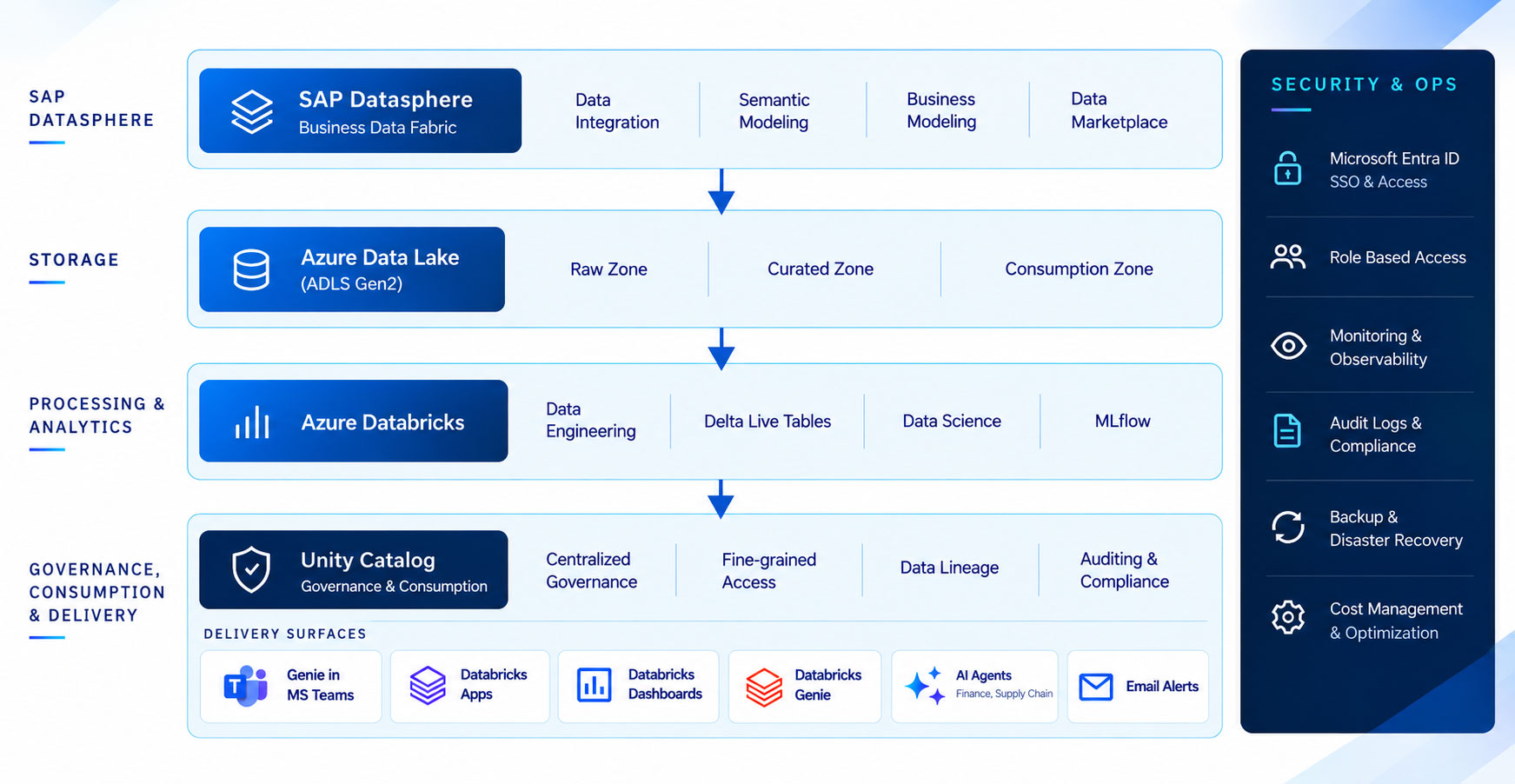
The hard part was not the platform, it was keeping SAP's business meaning intact once data left SAP. Applexus integrated SAP Datasphere with Azure Data Lake and Azure Databricks so that plant, product, and planning semantics survived into the lakehouse, giving models features that reflect real operations rather than raw tables. Applexus then built the data engineering, feature engineering, model training, and MLOps pipelines on Databricks, with Unity Catalog governing lineage, security, and access.
Applexus also took responsibility for adoption, delivering forecasts into dashboards, applications, Microsoft Teams, and AI-driven experiences so planners consume them inside existing workflows rather than in a separate analytics tool. The result is a platform the client's own teams can extend, and a foundation for AI-driven automation.
Built for Trusted Enterprise AI
Applexus designs for the enterprise standard SAP customers expect: models operate only on trusted data, with security, lineage, and centralized governance maintained across the analytics lifecycle.
Measured outcomes and lasting change
- Forecast accuracy. Improvement in forecast accuracy, enabling more reliable planning across supply chain operations.
- Unified planning. One AI forecasting engine supports inventory management, production capacity planning, equipment allocation, and procurement planning.
- Smarter inventory decisions. Dynamic safety stock calculations replace static reorder points, reducing the likelihood of both stockouts and excess inventory.
- AI-ready foundation. A governed enterprise data platform now supports future AI agents capable of assisting with increasingly autonomous business decisions.