
Enabling Talk to Your Supply Chain to Reduce Planning Time
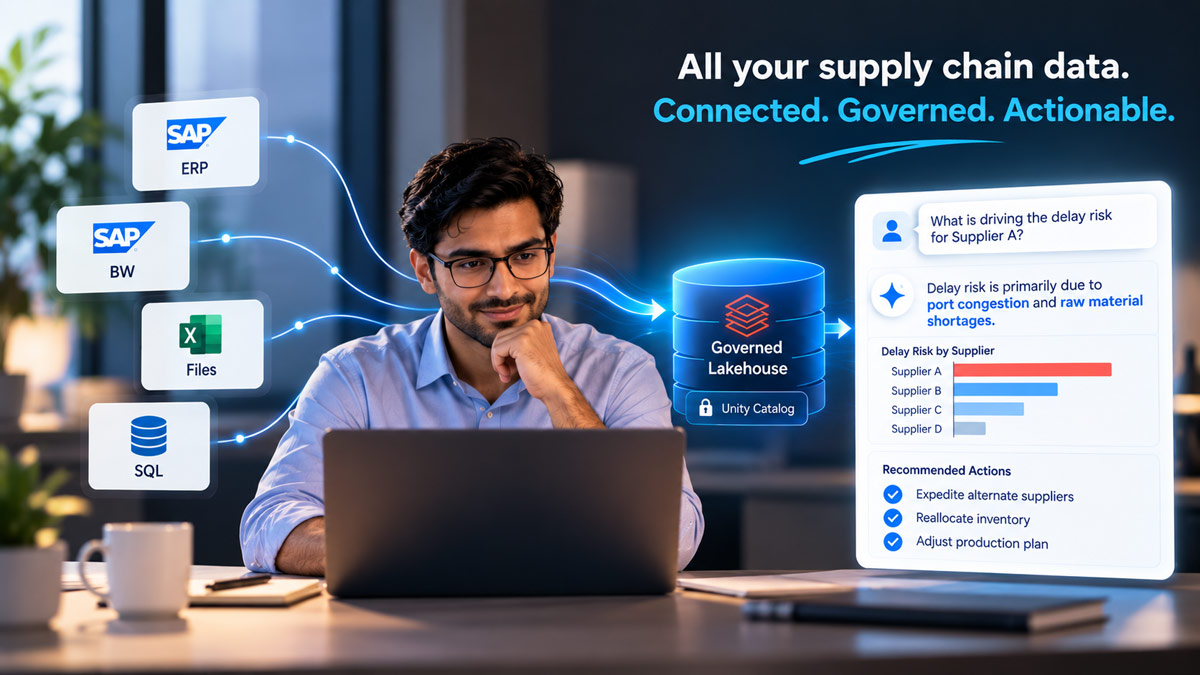
A global technology company unified fragmented SAP and non-SAP data on a governed Databricks lakehouse, giving supply chain teams one trusted foundation to query in plain language.
A natural-language assistant is only as good as the data behind it.
A global technology company wanted supply chain teams to ask questions of enterprise data in plain language and get trusted answers. Fragmented SAP and non-SAP data, redundant copies, inconsistent governance, and slow data onboarding stood in the way. Following the Applexus Momentum Framework, Applexus built a unified, governed Databricks Lakehouse, supported by a metadata-driven framework for data ingestion and Unity Catalog for secure data sharing without duplication
 Enlarge
Redundant data across many domains, and no single version of truth
Years of growth left operational data scattered across cloud applications, source systems, and file repositories, each with its own toolset, metadata, and access rules.
- Copies everywhere. Each application copied the same data into its own store, so multiple versions accumulated, and security, quality and governance had to be re-established per store.
- Slow, fragile movement. Manual extracts and scheduled file transfers added delay and cost and were prone to failure.
- A pipeline per dataset. Every new source needed a hand-built pipeline, and there was no shared analytics layer to reuse work.
- Pressure on SAP. Real-time access to source systems at scale risked degrading transactional performance.
A natural-language supply chain assistant cannot answer reliably when it must reach into a dozen disconnected systems.
Target state: zero duplication, one version of data.
One platform. One copy of the data. Shared, not duplicated.
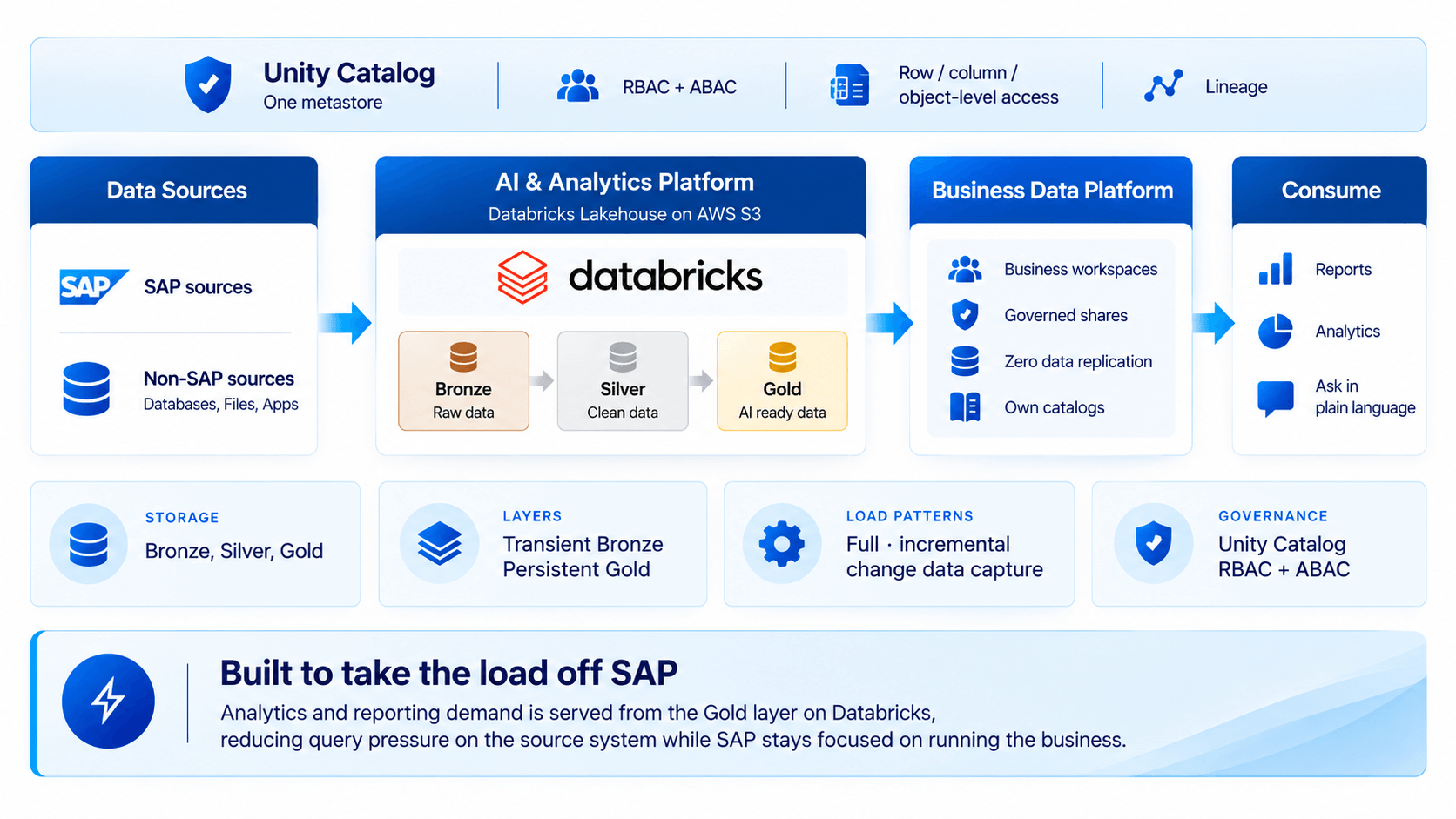
- A governed lakehouse. Sources land through a Spark JDBC, metadata-driven framework and are refined through Bronze, Silver and Gold layers on Databricks and Amazon S3.
- Sharing by permission. Business teams consume data through Unity Catalog RBAC grants, a permission rather than a second copy. One metastore governs both platforms.
- Load taken off SAP. Analytics is served from the Gold layer, shielding SAP from query pressure and scaling to heavy concurrent demand.
- Security that moves with the data. SAP roles and row, column and object-level security carry through to Databricks and are enforced in Unity Catalog.
 Enlarge
One ingestion framework, configured not coded
Source connections, load type and validation rules live in a metadata database, so a new source is added through configuration. That is how onboarding moved from weeks to days.
- Configure the source in the metadata database. Connection, load type and validation rules, no pipeline rebuild.
- Load with the right pattern per source: full, incremental or change data capture.
- Detect schema drift, so source changes are flagged before they break a load.
- Validate every load against null, type and duplicate checks.
- Monitor each job with row-level metrics, run durations and a full audit trail.
- Extend beyond JDBC to APIs and streaming as new sources arrive.
Measured outcomes and lasting change
- ~50x faster loads. An ~800 million record load that ran in about two weeks now completes in roughly six hours.
- •7-day onboarding. A new source reaches production in a week, down from several weeks.
- Zero copies. One copy in the IT Owned Data Platform, shared to the business through RBAC grants rather than replicated.
- Security in step. SAP authorizations carry through to Databricks automatically.
"Before supply chain teams could ask their data a question, the data had to agree with itself. One governed copy, onboarded in days and secured from source to answer, is what makes natural-language analytics trustworthy"
Figures are drawn from delivery records. The load improvement reflects rebuilding the relevant logic on base tables and running it in parallel on Spark.