Connecting Railroad Spend to the Operations Behind It - One Trusted Data Foundation in 6 Months
Applexus brought SAP finance, procurement and workforce data together with operational data on Databricks, giving business teams governed, near real-time answers in Power BI and plain-English Genie spaces.
The data to run a railroad existed. It never sat in one place.
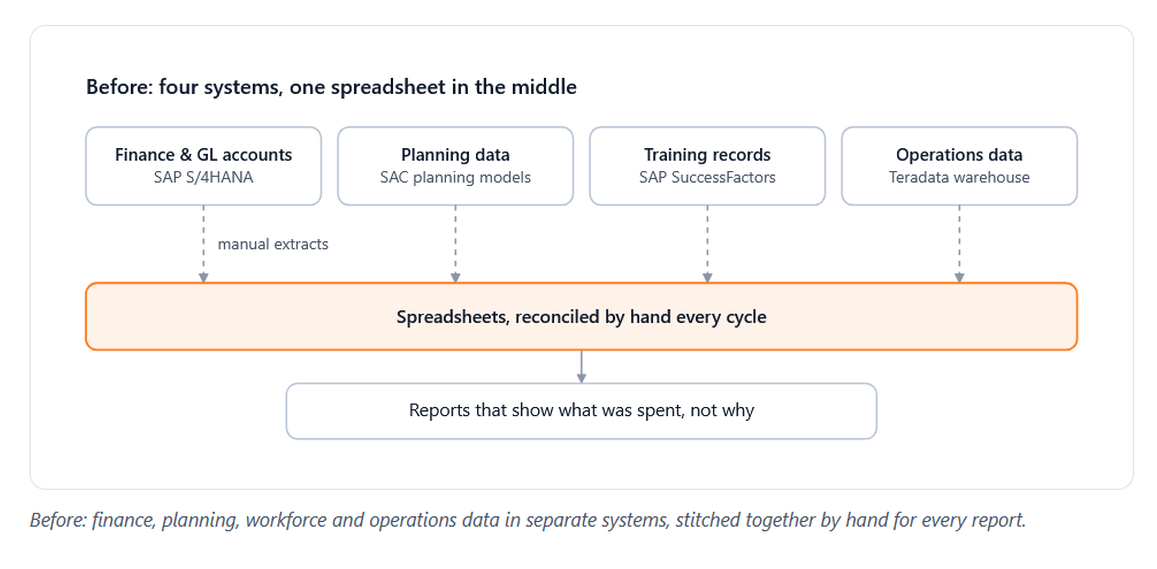
A leading North American freight railroad had already invested in the right platforms: SAP Business Data Cloud, Databricks and Unity Catalog. Yet finance, GL and purchasing data lived in S/4HANA, plans and forecasts in SAP Analytics Cloud planning models, training records in SuccessFactors, and locomotive, railcar and labor-claims data in a legacy Teradata warehouse.
Analysts joined them by hand for every reporting cycle. Leaders could see what the railroad spent, but not easily why. Applexus turned the platform investment into a governed data foundation that ties every dollar to the operations behind it.
 Enlarge
Three gaps between the data and the decisions
- Spend without the story. Finance could report budget, forecast and actuals. Tying a cost swing to its operating drivers, such as fuel, crew starts or equipment activity, meant pulling from several systems by hand.
- Manual work in the critical path. Analysts extracted, reconciled and reformatted data before every cycle. Each new business question started another one-off extract.
- Security that could not travel. Access rules lived in SAP, built on cost-center hierarchies and HR master data. Without the same rules on the new platform, sensitive financial and employee data could not move at all
The platform was in place. What was missing was a governed, repeatable way to bring SAP and operational data onto it.
Without it, every new report was a project of its own, and the platform investment could not pay back.
A data factory, not a one-off integration
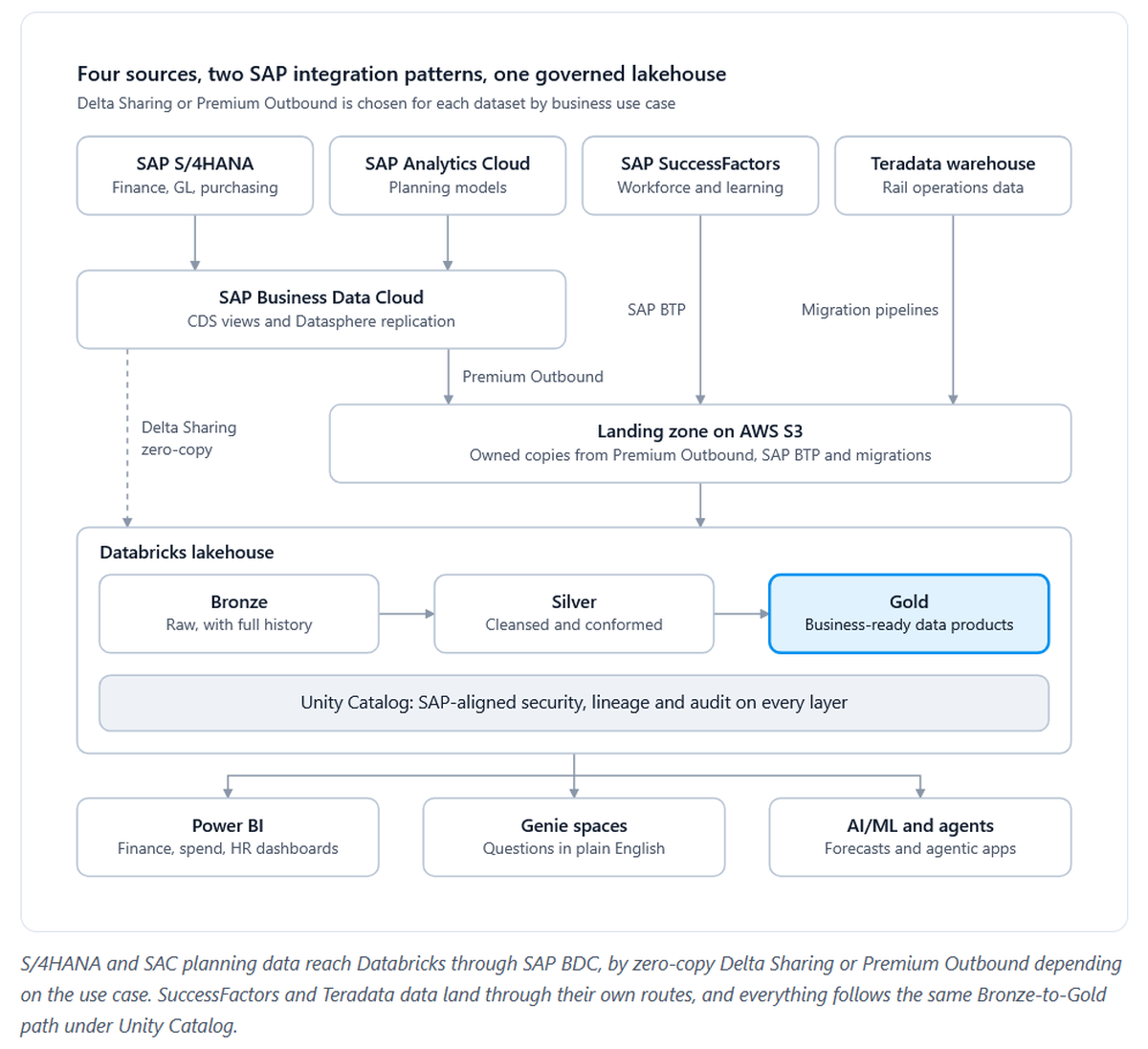
- The right integration for each use case. SAP data flows through either Delta Share or Premium Outbound Integration, based on the business use case, into the railroad's Databricks Delta Lake. Where a use case needs an owned copy, Premium Outbound lands it in the railroad's own AWS storage, so analytics keep running at multi-terabyte scale, independent of SAP availability.
- Every new dataset follows the same path. A metadata-driven ingestion framework and Bronze, Silver and Gold layers make onboarding a matter of configuration, not custom code. Applexus accelerators generate SAP CDS views and Datasphere replication flows in hours instead of weeks.
- SAP logic and security come along. Hierarchies are flattened, SAP functions such as currency and unit conversion are rebuilt natively, and SAP row- and column-level security is mirrored in Unity Catalog. People see in Databricks exactly what SAP cleared them to see.
- Operational history moves in, too. Locomotive, railcar and labor-claims data was migrated off Teradata, making Databricks the system of record for operations.
- Answers in plain English. Certified Gold data products feed Power BI dashboards and Databricks Genie spaces, so a finance lead can ask "Why did transportation operating costs rise last quarter?" and get a governed answer.
 Enlarge
Six steps from SAP table to business answer
- Request a dataset; the business owner confirms what is needed and how often it changes.
- Expose the SAP tables through delta-enabled CDS views, generated in bulk by an Applexus utility.
- Share or replicate each dataset through SAP BDC: zero-copy Delta Sharing, or Premium Outbound initial and change loads via generated Datasphere replication flows, depending on the use case.
- Refine data from raw (Bronze) to cleansed (Silver) to business-ready (Gold) with config-driven Lakeflow pipelines.
- Validate every load with data-quality rules and column-by-column reconciliation against the source.
- Answer business questions in Power BI, Genie spaces and AI/ML models, all governed by Unity Catalog.
Beyond the pipelines
- Every cost now has a cause: Finance compares budget, forecast and actuals, then drills from a summary variance to the transaction, next to the fuel, crew and equipment data behind it.
- Procurement sees the whole spend: Purchase orders, contracts, vendors, inventory movement, and fuel and freight costs share one model, supporting spend, vendor-performance and savings analysis.
- Compliance is tracked, not chased: Training completions and certification expirations are visible by organization and role, so supervisors act before a safety certification lapses
- Nothing that worked was broken: Around 80 SAP reports already in production kept running untouched while the new platform went live.
- The next domain is an extension, not a project: Onboarding is configuration-driven, and the governed Gold layer is ready for AI/ML and agentic analytics from the first release.