



Reconciling Every Delivery Against Contract in Real Time - Cutting Manual Effort by 70%
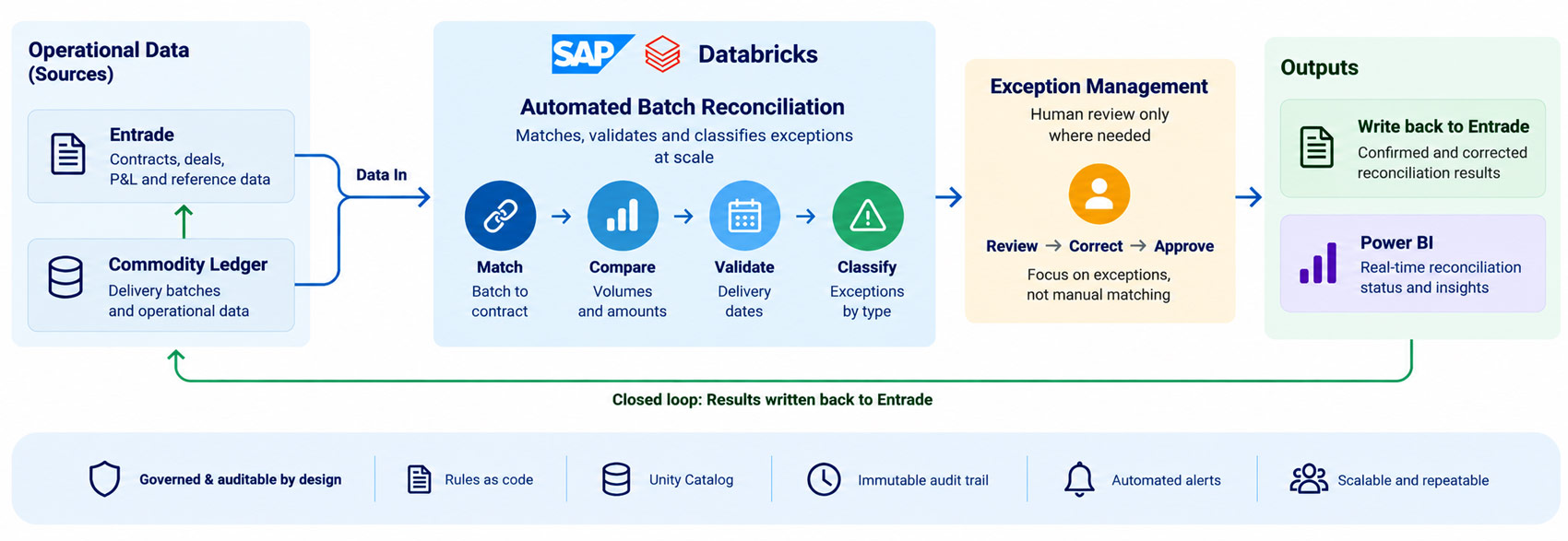
Applexus rebuilt batch-to-contract reconciliation end to end on SAP Databricks, with live data ingestion, rules as code, automated matching, and controlled writeback to Entrade.
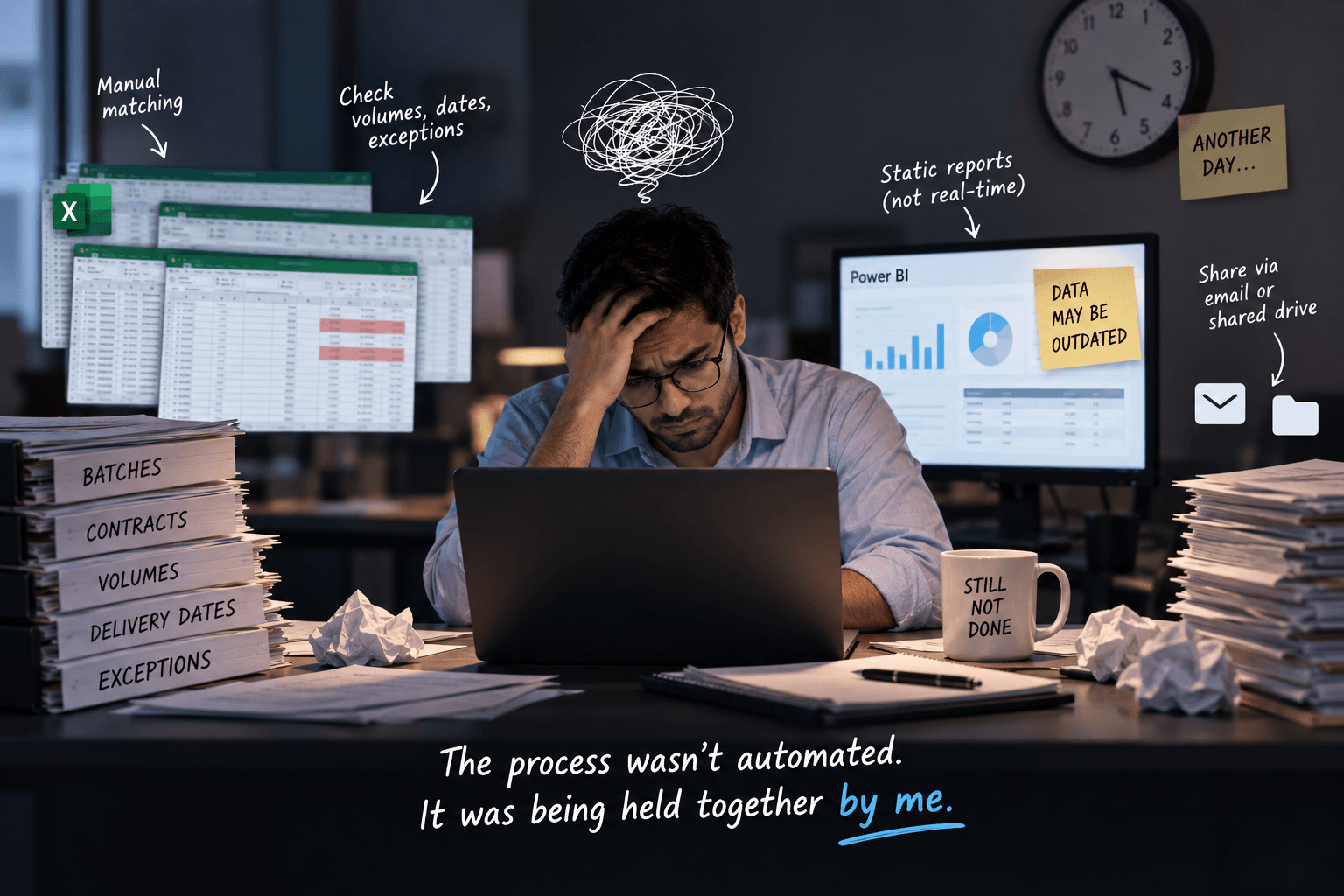
A settlement-critical process was running on offline spreadsheets.
An energy and commodities operation reconciled every delivery against its contracted position before settlement and invoicing, in Excel, from a static data package, with results circulated by email. The process worked, but the foundation behind it did not scale. Disconnected data, manual controls, limited governance, and dependence on individual knowledge created growing operational risk. Applexus replaced it with an automated, governed pipeline on SAP Databricks.
 Enlarge
Before: batch matching, volume and date checks, and exception handling all carried by one analyst in spreadsheets.
Three exposures hiding inside a process that looked like it worked
- No control layer. Batch matching, volume comparison, date validation and exception classification all ran in spreadsheets, with no enforced validation, no version control, no access control and no audit trail.
- Decisions on stale data. Power BI consumed exported files, never live feeds, and nothing called Entrade. Every report was a snapshot hours or days old.
- One person deep. The whole process depended on individual analyst knowledge of an undocumented spreadsheet, with results handed off by email or shared drive rather than written back through a controlled interface.
The offline spreadsheet and Power BI model was not a designed solution. It was a workaround that had become an operational dependency.
It carried material risk to settlement accuracy, regulatory compliance, and operational resilience.
Reconciliation rebuilt as governed code on SAP Databricks
- No more stale decisions. The pipeline ingests live data instead of static exports.
- Matching that cannot drift. Batch-to-contract matching, volume and date comparison, and exception classification run as version-controlled code, with tolerances configured per contract rather than one system-wide approximation.
- A writeback you can trust. Confirmed results go back to Entrade automatically with conflict detection, and manual corrections require dual approval with segregation of duties.
- An audit trail that stands up. Every event lands in an immutable Delta table, governed by Unity Catalog and documented in runbooks.
 Enlarge
SAP Datasphere was evaluated first. Integration limitations led the team to restructure the architecture on SAP Databricks for more efficient and scalable data processing.
Six steps, end to end, without a spreadsheet
- Extract deal and contract data from Entrade.
- Match Commodity delivery batches to the contracts they belong to.
- Compare volumes and delivery dates against contracted positions.
- Resolve exceptions, identified, classified and corrected under dual approval.
- Write back confirmed results to Entrade through a controlled interface.
- Confirm the reconciliation report, with every delivery validated before settlement and invoicing.
Beyond the hours saved
- Audit posture moved from deficiency to strength. Every ingestion event, rule evaluation, classification, exception action, writeback attempt and approval is timestamped in an immutable table.
- Settlement accuracy improved. The three causes, silent formula errors, stale-data decisions and incorrect manual writebacks, are each addressed by design.
- Volume growth stopped being a redesign. The pipeline handles any number of products and batches; the spreadsheet approach did not.
- Key-person risk removed. Documented in code and runbooks and governed by Unity Catalog, so any trained analyst or engineer can run, monitor and troubleshoot it.