


AI Built In, Not Bolted On: What AI-Embedded AMS Actually Looks Like
29 July 2026




Gopal Raman
Vice President- AMSGopal Chittur Raman, Vice President – AMS at Applexus Technologies, brings over 30 years of distinguished experience in Delivery Management. His expertise spans IT operations, Program...
Every SAP managed services provider says they use AI now. Spend a few minutes on vendor websites and you'll see the same promises repeated everywhere: AI-powered support, AI-enabled operations, AI-driven service delivery.
Ask a simple follow-up question: where does AI actually live in your support operation? There's a roadmap slide. Maybe a chatbot on the front end. Maybe an automation initiative that's still being rolled out.
Meanwhile, behind the scenes, the same ticket queues, handoffs, and dated knowledge continue to run the show. That distinction between AI bolted onto an AMS model and AI built into one is going to be the most critical question you can ask an AMS Service provider. And over the next few years, that distinction is going to matter far more than many organizations realize.
The bolt-on problem
Most SAP application management services operations were designed a decade ago.
Tickets arrive, get manually classified, sit in a queue, and land with whichever consultant is free. Knowledge lives in the heads of a few senior people. When they’re on leave or they leave, resolution times spike.
The process works. Until it doesn't.
Adding an AI feature to the front of that process doesn't really change the process.
A chatbot sitting in front of a manual workflow is still sitting in front of a manual workflow.
The queue is still the queue.
The bottlenecks are still the bottlenecks.
The tribal knowledge is still tribal.
The easiest way to test this with a provider is simple: ask them to show you AI working inside the ticket lifecycle. If the answer is a slide, you have your answer.
What “built in” actually means
In an AI-embedded AMS model, AI isn't a feature sitting on the edge of the operation. It's woven into how the operation runs. The difference shows up at every stage of the support lifecycle. Sometimes it shows up before a ticket even exists.
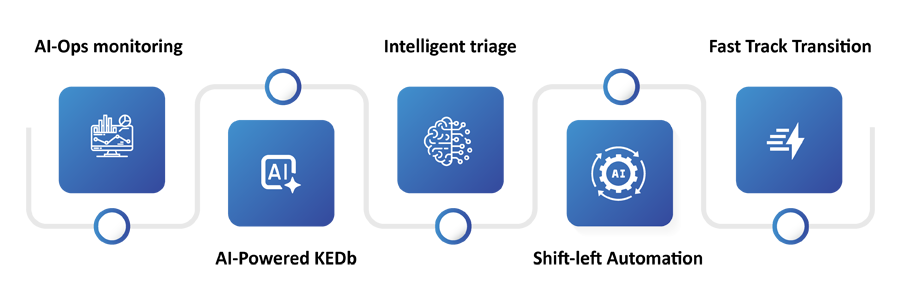
1. Issues get caught before they become tickets
The best support ticket is the one nobody ever has to raise.
Modern SAP landscapes generate huge amounts of operational data every day: memory consumption, background jobs, database growth, failed interfaces, certificate expirations, and performance trends. When those signals are monitored together, patterns start appearing before users feel the impact.
Instead of a P1 incident at 2 in the morning because a certificate expired overnight, someone receives an alert the previous afternoon that the certificate is due to expire tomorrow. The conversation shifts from firefighting to prevention.
2. Every past resolution starts working for you
Traditional AMS models rely heavily on experience.
Experienced consultants know where to look, what questions to ask, and which fix worked last time. That's valuable knowledge. It's also risky knowledge if only a handful of people have it.
An AI-indexed knowledge engine changes that by making previous resolutions searchable and reusable the moment a similar issue appears. A consultant investigating a ticket isn't starting from zero. They're seeing previous fixes, similar incidents, supporting documentation, and relevant community guidance within seconds.
An AI-indexed engine eliminates the tribal knowledge risk.
3. Tickets get routed by impact, not by just severity
Natural-language triage reads each incoming ticket and routes it to the right functional team automatically. Assignment goes one step further than “who has the shortest queue” — it weighs the complexity of what each consultant is already working on. The right person gets the right issue, faster, with a full audit trail.
4. Resolution starts moving left
One of the more interesting things about an AI-embedded AMS operation is that it becomes more efficient over time. Issues that once needed an L3 begin moving to L2 or L1 support.
Some disappear from the queue altogether through automation. The business impact is straightforward. Support costs start falling. At the same time, senior experts spend less time firefighting repetitive issues and more time working on optimization and improvement initiatives. Each resolved ticket makes support faster, sharper, and more cost-efficient than the last.
5. Even onboarding gets accelerated
Transitions have always been one of the hardest parts of an AMS engagement. There are hundreds of documents, packed calendars, and years of context that need to move from one team to another. AI doesn't remove that complexity, but it can remove a surprising amount of friction.
Large documents can be summarized into practical briefing packs. Knowledge transfer sessions can be recorded, transcribed, and indexed automatically. Questions raised in one session become searchable in future sessions. Incoming teams arrive with context earlier and ramp up faster.
Why this matters right now
SAP customers are already making decisions around the 2027 mainstream maintenance deadline for ECC. Some organizations are moving to S/4HANA. Others are extending timelines or exploring hybrid approaches. Whichever the path, organizations will be running a complex landscape through a multi-year transition. That transition period is exactly when internal IT teams are stretched the most.
For many organizations, 70 to 80 percent of IT capacity is already tied up keeping existing operations running. When support teams spend less time chasing repetitive incidents, internal teams get time back for projects that move the business forward.
Beyond SLAs: measuring what the business feels
Traditional SLAs measure activity.
They tell you whether a response arrived within an agreed timeframe or whether a ticket was closed before a deadline expired. Those measures still matter. But they don't always tell you what the business actually experienced. Did month-end close run smoothly? Did employees who raised tickets describe the support experience as good?
AI makes it possible to connect operational measures with business outcomes and user experience signals and generate a single scorecard that can answer “whether the business was truly better off this quarter” rather than “whether the response times were met”.
The question to ask your provider
If there's one thing worth taking away from all of this, it's this:
Don't ask your AMS provider whether they use AI.
Ask them to show you where it lives.
Ask how a ticket gets routed at 3 AM.
Ask how previous resolutions are reused.
Ask what happened the last time a system started drifting toward failure before users noticed.
The answers reveal very quickly whether AI is part of the operation or simply part of the marketing story.
At Applexus, those conversations are some of our favorites because they move beyond buzzwords and into how support actually works in practice.
That's where the real distinction sits. Not in whether AI exists. But in whether it's built in or bolted on. See it for yourself.
Talk to our AMS expert now →