


SAP SuccessFactors - From Systems of Record to Systems of Intelligence
24 August 2026




Shyam Kumar
Associate Director, Applexus TechnologiesShyam Kumar is an Associate Director at Applexus with over 18 years of experience in SAP HCM and SAP SuccessFactors, backed by more than 10 years...
A sneak peek at SAP's connected agentic AI strategy, the Joule agents reshaping day-to-day HR, and what's on the roadmap next.
For years, HR technology focused on being a system of record. SAP's message through 2025 and 2026 points to a broader role for it. SuccessFactors is moving from systems built to store and process data toward systems designed to reason, anticipate, and act, with AI working across the employee lifecycle.
This blog focuses on how SAP SuccessFactors is putting this strategy into practice, the capabilities available today, and what SAP has signalled for the next stage.
1. The Core Idea: Connected, Suite-Wide AI
SAP has focused on connected AI across the SuccessFactors suite. For the 1H 2026 release, SAP highlighted connected, suite-wide AI, unified experiences, clearer and more compliant processes, and stronger foundations for workforce growth.
SAP describes a network of AI agents working across recruiting, workforce administration, payroll, learning, performance, and talent development. These agents share context across processes, helping employees get answers and complete tasks with fewer manual steps.
This approach also addresses fragmentation. An IDC business value study commissioned by SAP identified disconnected tools, duplicated data, and manual handoffs as significant sources of inefficiency. SAP links this fragmentation to the value organizations get from AI in HR. AI agents need unified data and connected processes to work across the business.
2. Joule: From Copilot to Agentic AI Platform
Joule is SAP's AI layer across its product portfolio. In SuccessFactors, Joule has evolved from a conversational assistant into a role-aware system designed to understand a user's job, permissions, and context before taking action.
Employees, managers, and HR teams can use natural language to access information, navigate the system, or complete transactions. Examples include requesting time off, accessing a compensation statement, or checking a promotion approval.
Joule also follows role-based permissions. Users do not receive data they are not authorized to access.
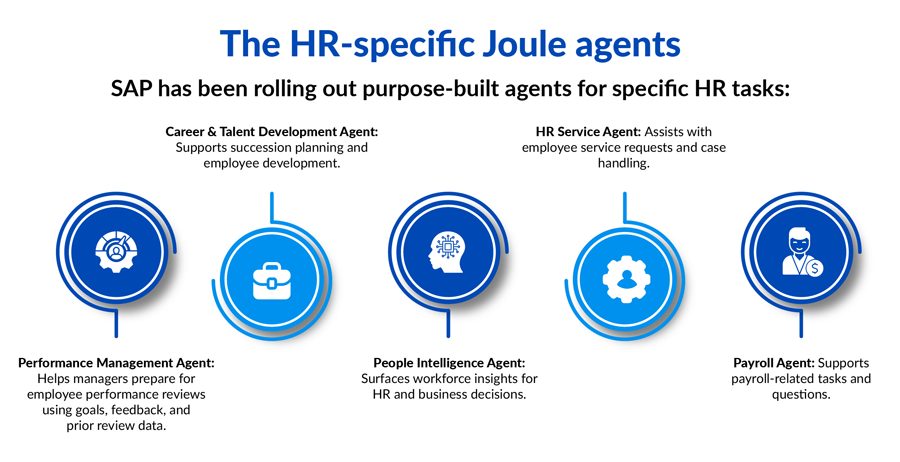
SAP has also introduced Joule Studio on SAP Business Technology Platform (BTP) AI Foundation. Enterprises and partners use Joule Studio to create custom agents, connect SAP and non-SAP data, and coordinate multi-agent workflows with governance and audit trails.
3. AI Across the Hire-to-Retire Journey
Recruiting: SmartRecruiters and Winston
SAP has integrated SmartRecruiters with SAP SuccessFactors solutions to bring AI further into hiring. The integration connects SmartRecruiters' AI companion, Winston, with Joule, with plans for the two to work as connected agents from 2026 onward.
The integration supports candidate applications, interview scheduling, candidate matching, and interview feedback while keeping recruiting data connected to core HR systems.
Learning: intelligent Q&A
The SAP SuccessFactors Learning 1H 2026 release introduced intelligent Q&A. Employees ask questions in natural language and receive context-aware answers based on their organization's learning content, along with relevant resources.
Workforce transformation at scale
In August 2026, SAP announced that NTT DATA selected SAP SuccessFactors with SAP Business Data Cloud, integrated with Joule as an AI orchestrator, to support its global people transformation.
SuccessFactors serves as the system of record for people and talent data, while SAP Business Data Cloud connects this data with insights from other areas of the business.
4. The Bigger Vision: Autonomous HCM
SAP has connected these capabilities to the Autonomous Enterprise and, within HR, Autonomous HCM.
SAP describes Autonomous HCM as a model where AI assistants and agents handle coordination work such as routing, matching, and administrative follow-through. HR professionals then focus more on judgment, decision-making, team development, and organizational trust.
SAP positions this approach around augmentation rather than replacement, with "human expertise elevated by AI" as the stated promise.
5. What's Coming in 2H 2026
SAP has confirmed the 2H 2026 SuccessFactors release schedule, with preview on October 12, 2026, and production on November 13, 2026. Key areas include:
- Continued rollout of the Joule HR agents, including Performance & Goals, Career & Talent Development, People Intelligence, HR Service, and Payroll, moving toward standard general availability across customer tenants.
- Deeper Winston and Joule integration in recruiting as SmartRecruiters and SAP SuccessFactors Recruiting continue to connect through 2026.
- Broader access to Joule Studio 2.0, extending agentic AI into customer and partner-built workflows on SAP BTP.
- Expansion of Workforce Scheduling, with AI-assisted shift and time scheduling, skills matching, and shift-swapping support.
- Continued development of People Intelligence for workforce analytics, including retention, compensation, and skills distribution.
- Ongoing platform deprecations supporting a modern, AI-ready foundation. These include retirement of the legacy home page experience and Partial Organization Single Sign-On, scheduled for November 13, 2026, alongside a shift toward SAP Identity Authentication Service (IAS).
- Continued focus on data unification through SAP Business Data Cloud and consolidation of core HR, time, and payroll. SAP positions this foundation as a prerequisite for broader AI agent value.
Note: SAP's release schedule and agent availability dates are subject to change. Organizations planning a rollout should confirm the latest status through SAP's official release notes and SAP Community roadmap pages.
6. Closing Thoughts
SAP's recent SuccessFactors announcements point to connected AI across recruiting, performance, learning, payroll, and workforce planning.
Data unification remains a key requirement. Fragmented systems and disconnected processes limit the context available to AI agents.
As more Joule HR agents move toward general availability, the practical question for SuccessFactors customers is less about the number of AI features available and more about whether their HR, time, and payroll data is ready to support them.
Sources: SAP News Center, SAP Community, SAP-sponsored and affiliated coverage, and Applexus, referenced throughout.