When Requirements Change: Keeping SuccessFactors Implementations on Track
28 October 2026




Archana Dewanpelli
Consulting LeadArchana Dewanpelli is a Consulting Lead at Applexus Technologies with over 18 years of professional experience, including more than 8 years in SAP SuccessFactors. Her expertise...
How to manage changes in SuccessFactors implementations without losing time or customer trust
The requirements have been agreed upon. The design has been approved. Configuration is complete. Then, during a demo or UAT, a stakeholder asks, “Can we do this differently?”
Sounds familiar?
In SuccessFactors implementations, requirements and priorities can evolve even after significant work has been completed. The challenge is not to prevent change, but to understand what is driving it, assess its impact, and manage it without compromising delivery or customer trust.
Why requirements change
In my experience, requirements evolve for four familiar reasons:
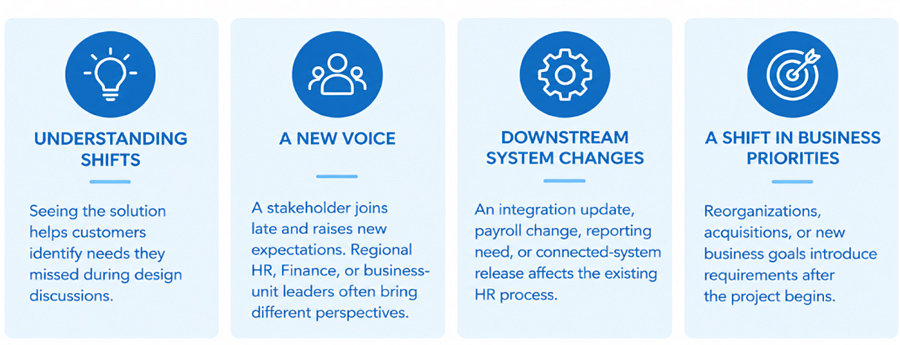
A structured approach helps the team understand each request, assess its impact, and make informed decisions.
Five questions for every change
For every new requirement, ask:
WHAT CHANGED? → WHY DID IT CHANGE? → WHAT DOES IT IMPACT? → WHAT ARE OUR OPTIONS? → WHAT DECISION DO WE NEED?
A realistic example
Consider a global SAP SuccessFactors Employee Central implementation for a customer operating in multiple countries. The agreed global promotion workflow is Manager → HR.
During UAT, three requests arrive:
- Headquarters: A new job architecture means promotions into senior leadership positions now require additional business-head approval.
- One European country: Employee representatives might need to be consulted before certain promotions take effect. The legal team must validate the obligation and identify the affected employee groups and transactions.
- Another country: Promotions with effective dates close to the monthly payroll cutoff can result in additional payroll adjustments. The team needs to assess whether the process should account for the payroll calendar.
These requests reflect business governance, a potential local compliance obligation, and payroll processing. Do not assume they all require a scope change or promise they can be accommodated without impact.
First, confirm the business need and determine whether the change is essential for day one or can safely wait. Then assess the impact on the global design, local configuration, workflows, data, integrations, testing, related deliverables, and delivery timeline.
Keep a global baseline, with justified local variations
- Business governance: Confirm whether the approval reflects a change in policy or a requirement missed earlier. Identify the positions or employee groups it applies to.
- Potential local obligation: Validate the legal and process requirements before deciding whether a country-specific process or configuration is necessary.
- Payroll concern: Investigate the underlying cause before changing effective-date rules. Better coordination or clearer guidance may resolve the issue without a system change.
The objective is to preserve a consistent global design while accommodating local variations supported by validated business needs, legal obligations, or operational requirements.
What does the change really impact?
A change does not automatically mean a timeline extension. Assess:
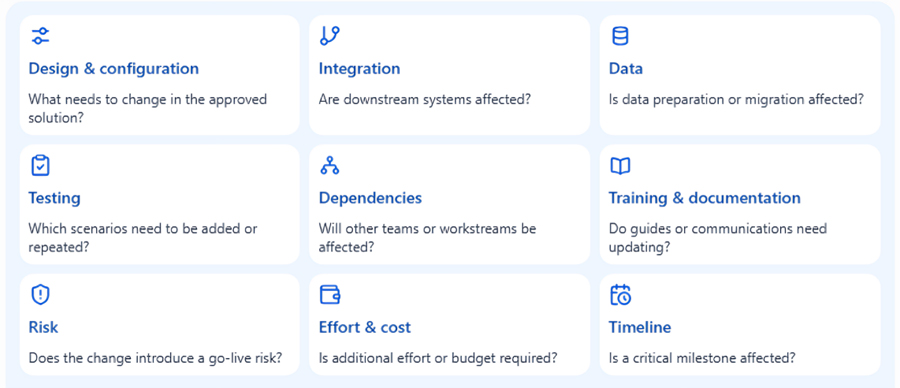
Not every change affects every area. Assessing the relevant impacts helps the team determine how best to accommodate the change without compromising delivery.
Protect the timeline without saying “No”
The key question is: How critical is this change for the initial business go-live? Does it address an essential business need, such as payroll processing, a validated compliance obligation, a critical approval, or an essential control? Or is it an improvement that can safely wait?
Consider three options:
- Deliver before go-live: Implement and test the full change if it is essential and feasible within the project plan, particularly when it relates to payroll, approvals, controls, or a validated legal or operational obligation. Make delivery risks and trade-offs clear.
- Deliver in phases: Implement the essential components now and schedule the remainder for a later phase. Document interim processes, limitations, owners, and follow-up dates.
- Defer to Phase 2: Postpone non-essential enhancements or changes that introduce disproportionate delivery risks. Record the decision, owner, and review date.
These options should be based on a thorough impact assessment. Do not defer critical requirements simply to protect the go-live date or put delivery at risk for low-priority enhancements without a clear business reason. The consultant’s role is to help customers make informed decisions.
Customers do not want surprises
Customers understand that changes have consequences. What frustrates them is discovering those consequences gradually, after a change has already been agreed upon. When additional effort, testing requirements, integration changes, or potential go-live delays emerge only later, the customer may lose confidence in the team, believing these impacts were not thoroughly assessed upfront.
Be transparent and avoid promising a date before the assessment is complete:
“We can assess this change within the current delivery plan. It will require an update to the approval design and additional testing. We will confirm the impact on the remaining UAT scenarios and dependencies before committing to a date. If a milestone is at risk, we will present options rather than wait until the delay becomes unavoidable.”
Five practices that help
- Assess before reacting. Understand the business reason behind the request and the problem it is intended to solve.
- Separate clarification from scope change. If the request is already covered by the approved design, explain it clearly. If it changes what was agreed, assess the impact and follow the project’s change-control process.
- Assess end-to-end impact before committing to dates. Review the design, configuration, testing, integrations, data, dependencies, and risks.
- Give the customer options. Explain what is required for go-live, what can be phased, and what requires additional effort or time.
- Make trade-offs visible. If something is added, explain what it consumes in terms of time, effort, testing capacity, budget, or other priorities.
Questions to work through with the customer
- What business process will fail or be materially affected if the change is unavailable on day one?
- Is it required for payroll, a validated compliance obligation, a critical approval, or another essential business control, or is it an improvement?
- If the full change cannot be delivered safely before go-live, is there an acceptable interim process or smaller first release available?
What customers can do to keep things on track
- Appoint a decision owner to consolidate requests and resolve conflicting priorities.
- Prioritize requests as must-have for go-live, should-have soon, or nice-to-have, and maintain a dated Phase 2 list.
- Involve end users early through design workshops and demos rather than waiting until final testing.
Change management is also customer experience
Customers might forget configuration details, but they remember whether the team listened, explained the impacts, offered options, and helped them make decisions.
Good change management is not about saying “No” to the customer. It is about making sure every “Yes” is well understood and consciously managed.
Final thoughts
Changing requirements are inevitable in implementation projects. What makes the difference is how well the team navigates the uncertainty, balances competing priorities, and keeps the business outcome at the center of every decision.
A successful implementation is not one where nothing changes, but one where change never loses sight of the value the solution is meant to deliver.