


The SuccessFactors Recruiting Clock Is Ticking: Your Roadmap to SmartRecruiters
08 October 2026




Shyam Kumar
Associate Director, Applexus TechnologiesShyam Kumar is an Associate Director at Applexus with over 18 years of experience in SAP HCM and SAP SuccessFactors, backed by more than 10 years...
A few months ago, moving from SAP SuccessFactors Recruiting to SmartRecruiters might have sounded like a “do we really need to?” conversation. It still might. SAP closed its acquisition of SmartRecruiters on September 11, 2025, and has made its direction clear: SmartRecruiters is where its recruiting investment is heading. But that does not mean existing SuccessFactors Recruiting customers have to move right away. SAP is honoring existing contracts and has talked about flexible, customer-led paths for integration and migration.So the question isn’t really, “When are we being forced to switch?”
It is, “Where is recruiting headed, and does it make sense to start planning now?”
What we know for sure
SmartRecruiters is SAP's next-generation recruiting product, and new recruiting capabilities are being built around it. At the same time, existing SuccessFactors Recruiting customers aren’t being pushed into an immediate migration.
SAP has also been building the tools to make the transition easier.
The Migration Hub now includes a Configuration Analyzer that reviews your existing SuccessFactors Recruiting setup, flags compatibility issues, and supports migration once your mappings have been reviewed. The Connectivity Hub helps manage position, job, and organizational data between the two platforms.
There’s movement on the AI side too. SmartRecruiters’ AI assistant, Winston, is becoming part of the SAP ecosystem, with SAP planning for Winston and Joule to work together as coordinated agents.
Customer feedback also gives us some useful context. Gartner Peer Insights reviews of SmartRecruiters for SAP SuccessFactors include enterprise talent acquisition teams pointing to areas where the older recruiting module falls short, especially for larger global organizations. Reviewers also mention faster application processing and easier navigation with SmartRecruiters. Customer feedback also gives us some useful context. Gartner Peer Insights reviews of SmartRecruiters for SAP SuccessFactors include enterprise talent acquisition teams pointing to areas where the older recruiting module falls short, especially for larger global organizations. Reviewers also mention faster application processing and easier navigation with SmartRecruiters.
This isn’t a weekend migration. The good news is that much of the foundation is already there.
Native integration covers more ground than it used to. SAP’s Integration Hub now handles several key processes out of the box, including user sync from Employee Central, position-to-job creation, and Hire Sync.. Hire Sync can send candidate information to Employee Central’s Manage Pending Hires or trigger Onboarding after an offer is accepted.
The harder work tends to sit around the edges. Think custom fields, configurations that don’t map cleanly, third-party tools for assessments or background checks, sourcing platforms, reporting feeds, data warehouses, and identity management.
Onboarding is mostly automatic now, with some manual cleanup. T You no longer have to build the entire hire-to-onboard handoff yourself. Native Hire Sync handles much of it. There can still be some manual work on the Employee Central side, especially where mandatory fields are involved. Status tracking across both systems also has limitations. The safest approach is to test the full process against your own configuration before assuming everything will work out of the box.
Figure out what happens to old data. You’ll need a clear plan for historical requisitions and candidate records.
Do you migrate them? Archive them? Keep read-only access to SuccessFactors Recruiting for compliance and reporting?
Candidate data rules still apply after the platform changes. Make sure SmartRecruiters can support the reporting and retention requirements you have today before you switch anything off.
Don't skip change management. Recruiters and hiring managers will be learning a new system while hiring is still happening.
A phased rollout by region or business unit can make the change easier to manage than a big-bang launch. It also means you’ll likely run both systems for a period, so plan for that.
Rough timeline, if you're planning
There’s no universal migration timeline. Your starting point depends heavily on your configuration, integrations, data, and rollout strategy.
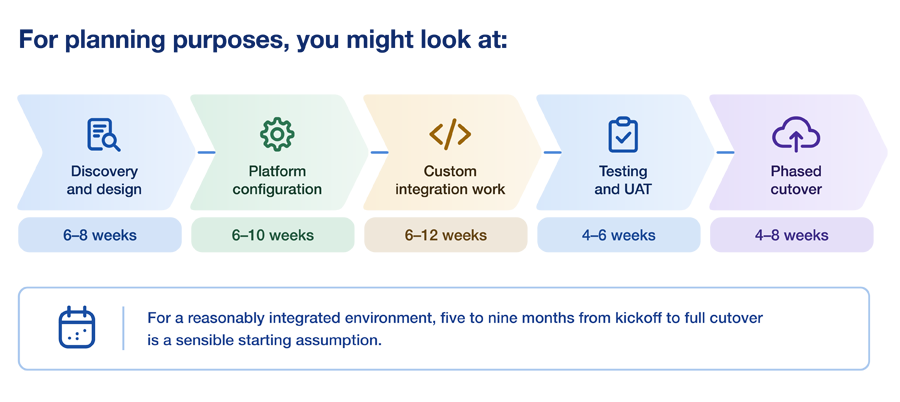
A simpler setup could take less time. And as SAP’s native migration and integration capabilities mature, some of the heavier work should become easier.
Things worth asking yourself first
Before building a migration plan, take a close look at your current environment.
- Which integrations are genuinely custom, and which are already covered by SAP?
- How closely is Recruiting connected to Employee Central and Onboarding?
- What happens to your historical candidate and requisition data?
- Are you ready to run two systems during a phased rollout?
- Who will own the integration layer after go-live?
- And what will the total cost look like over the next three to five years?
- Those answers will tell you much more than a generic migration checklist ever will.
Bottom line
This isn’t a forced switch with a hard deadline. But it is a change worth planning for. SAP has made its direction clear, and the tools supporting the move are getting better with each release. The companies that benefit most won’t necessarily be the ones that migrate first. They’ll be the ones that understand their current architecture, separate custom work from what SAP now provides natively, and build a migration plan around where the technology is today. Done well, this is more than a recruiting platform change. It’s an opportunity to rethink the entire hire-to-onboard process while more of the technical groundwork is already in place.
Where does your organization stand today? Share your questions, concerns, or migration plans in the comments. Let’s start the conversation.