

Reimagining SuccessFactors Support: From Tickets to Intelligence: An AI-First AMS Model
01 September 2026




Shyam Kumar
Associate Director, Applexus TechnologiesShyam Kumar is an Associate Director at Applexus with over 18 years of experience in SAP HCM and SAP SuccessFactors, backed by more than 10 years...
From Reactive Support to AI-First Support
Traditional SuccessFactors AMS is reactive.
User → Ticket → L1 → L2 → L3 → Resolution
Every issue starts with an analyst understanding what happened before work begins.
AI-embedded AMS changes the starting point. A user describes the issue in natural language, such as, “My manager is unable to approve my leave” AI interprets the request, asks for context, and guides the user toward resolution. SAP Joule already supports informational, navigational, and transactional use cases across SuccessFactors.
Understand → Diagnose → Recommend → Execute
This is the foundation of an AI-first support model.
AI Transforms the Repetitive Layer of Support
A large share of SuccessFactors support involves recurring requests, from password resets and workflow questions to missing goals, payslip access, and HR policy lookups.
AI shifts these interactions toward self-service. Joule understands natural-language questions, retrieves relevant information, and guides users through supported processes.
Traditional: L1 → L2 Functional → L3 Specialist → SAP / Product Engineering
AI-First: Employee/Manager → Conversational AI (Joule) → AI-Assisted L1 → L2/L3 Specialists → SAP / Product Engineering
AI handles routine scenarios while human experts focus on issues requiring judgment.
Knowledge Management Becomes a Competitive Advantage
Support knowledge sits across SAP Help, Notes and KBAs, project documentation, SOPs, past tickets, and consultant experience.
AI brings these sources together with customer configuration, support history, and known issues. An analyst can ask, “Has this customer experienced this issue before?” and retrieve relevant context.
Incident → Resolution → Knowledge → AI → Faster Resolution
Knowledge becomes reusable and available when the next incident occurs. An AI-powered known-error database can match new incidents with proven fixes, helping analysts reach resolution faster and more consistently.
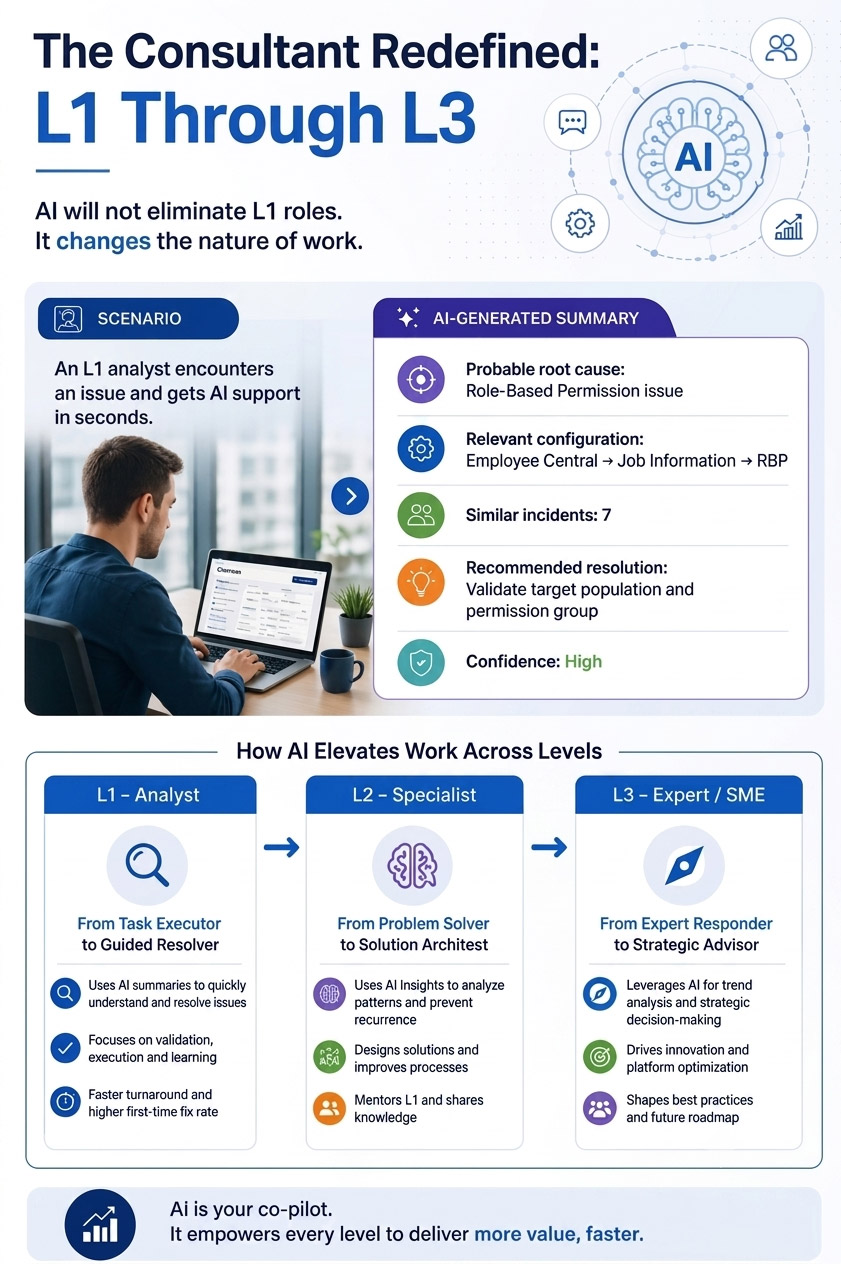
Intelligent triage produces this kind of impact-scored, context-rich handoff before an analyst opens the ticket.. The analyst moves from manual investigation to validation and decision-making. For a support Analyst the key skills now will include SuccessFactors architecture, business processes, AI-assisted diagnosis, RBP, integrations, and exception handling.
At L2/L3, AI correlates job information, event reasons, business rules, workflows, and integrations to help answer questions such as, “Why did the promotion workflow fail for these employees?”
AI WILL not replace functional expertise; it simply amplifies it. The fundamental skill shift for every level is moving from knowing where the answer is to knowing whether the answer is correct.
From Incident Resolution to Incident Prevention
The bigger opportunity here is not resolving tickets faster but, preventing them from recurring.
If one RBP issue generates 150 tickets in six months, traditional AMS focuses on SLA performance. An AI-first model asks why those tickets keep occurring.
Detect → Analyze → Identify Root Cause → Automate → Prevent
The objective shifts from closing more tickets to creating fewer.
AI-Assisted Release Management
Not every SuccessFactors release feature is equally relevant to every customer. AI correlates release changes with enabled modules, configuration, custom objects, and past incidents to create a customer-specific impact assessment.
High impact: Employee Central, Workflow, RBP | Medium: Recruiting | Low: Learning
Recommended actions: 12 regression scenarios, 3 business rules to validate, 2 integrations to review
AMS moves from release support toward continuous optimization.
Support Becomes Proactive
Traditional support starts when something breaks and a user reports the issue.
AI-assisted monitoring looks for patterns earlier, including unusual integration failures, rising workflow errors, permission-related incidents, and data-quality problems.
AIOps monitoring in AMS Elevate works this way, flagging drift and anomalies ahead of an outage rather than waiting for a ticket. SAP is moving in the same direction. In 2026, SAP introduced Joule in SAP for Me as an AI-powered gateway for support and self-service, including agentic case resolution.
A New AI-First AMS Operating Model
The model connects five layers:
Conversational self-service (Joule resolves routine requests without a ticket), → AI-assisted L1 (classification, retrieval, response generation) → AI-enabled L2/L3 (accelerated root-cause analysis) → AI operations (monitoring incidents and release signals to catch problems early), → Continuous optimization (using support data to eliminate recurring problems)
Self-Service → AI Support → Human Expertise → Automation → Prevention
How Applexus Helps Customers Make the Shift
Applexus combines SuccessFactors expertise, AI, automation, customer knowledge, and human judgment across the support lifecycle.
AI-Enabled L1 Support: AI classifies requests, retrieves knowledge, and recommends resolutions for analyst validation.
Applexus AI Knowledge Layer: Customer configuration, SOPs, prior incidents, and delivery knowledge form one contextual, queryable asset.
Beyond Joule — Applexus helps identify where conversational AI creates the most measurable value across a customer's specific landscape, moving the conversation from AI adoption to AI value realization.
AI-Assisted L2/L3 Support: AI supports complex areas such as Employee Central, Compensation, Payroll, Integrations, and Workflows.
AI-Powered Release Intelligence: Release changes are assessed against customer-specific configuration.
Reactive to Proactive AMS: Support data helps identify recurring incidents and address their root causes.
Iris Platform & AI Accelerators: An intelligent layer around the SuccessFactors environment, bringing incident history, recommendations, and analytics into one support view.
Applexus stages the journey:
Assess → Enable → Automate → Predict → Optimize
AMS Elevate: Applexus's AI-Embedded AMS Platform
Applexus has operationalized this vision through AMS Elevate – the AI-embedded Application Management Services offering.
AMS Elevate embeds AI across the support lifecycle. AIOps monitoring flags anomalies such as memory drift before an outage. Intelligent triage scores business impact and prioritizes incidents. AI-powered KEDb matches incidents with proven fixes. Shift-left automation remediates qualifying issues without human intervention.
AMS Elevate provides L1-L3 technical, functional, and BASIS support through flexible engagement and delivery models.
Reported outcomes include up to 40% cost reduction versus internal IT, 99%+ production uptime, and 30-50% repeat-ticket reduction through AI-powered KEDb.
For SuccessFactors customers, AMS Elevate provides the delivery model for moving from reactive ticket resolution to proactive, intelligence-driven support.
Measuring the Value of AI-Enabled Support
Traditional metrics still matter, including ticket volume, SLA compliance, resolution time, and backlog.
AI-first AMS adds self-service adoption, automation coverage, ticket deflection, repeat-incident reduction, prevented incidents, and AI-assisted resolution.
The key question becomes:
“How much support demand did we eliminate?”
Conclusion: Fewer Tickets, Not More
AI is changing how users ask for help, how analysts investigate, how consultants use knowledge, and how AMS teams manage releases.
Traditional AMS: Tickets → People → Resolution
AI-Assisted AMS: Intent → AI → Human Expertise → Resolution
AI-First AMS: AI → Automation → Prevention → Continuous Optimization
The goal for the next generation of SuccessFactors support is no longer “How quickly can we close the ticket?” but “How intelligently can we prevent the next one?” — the real promise of an AI-first SuccessFactors support engagement with Applexus