


Global Drives Manufacturer Standardises Pricing Across Production and Sales Units
Overview
The client is a leading global manufacturer of energy-efficient drives and motors, supplying industrial sectors from aviation to civil infrastructure. With production plants and sales operations across Asia, Europe, and North America, its system drives division needed a faster and more reliable way to set and approve prices.
Pricing for the division had always been run in spreadsheets. Agreement data, price setting, and multi-stage approvals were all maintained manually, making the process slow, error-prone, and heavily dependent on individuals. Each local sales unit had also developed its own pricing approach over time, so the division set out to establish a single governed pricing platform and one unified process across every country it sells into.
Key Challenges
Pricing a global product portfolio through spreadsheets had left the division without speed, consistency, or visibility. It needed a governed system of record before it could standardise how prices were set.
- Spreadsheet-dependent pricing - Agreement data and price setting were maintained entirely in spreadsheets, with no validation and no system-level control over how prices were built.
- Slow, multi-stage approvals - Approving an agreement or a price list involved several sequential manual phases, so closing a customer deal took considerably longer than the business wanted.
- Two-tier pricing structure - Products are manufactured by production units that hold no customer pricing, then made sellable by local sales units that apply their own market factor to reach a sales price.
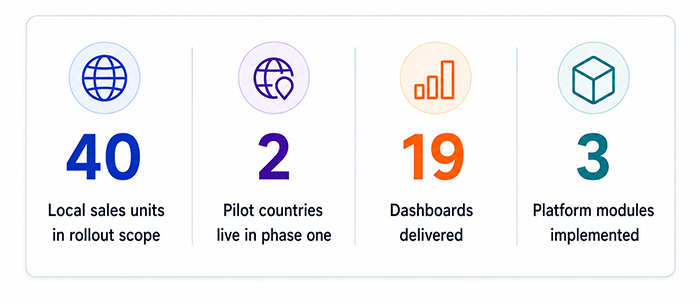
- Fragmented pricing strategies - Each of the roughly 40 local sales units operated its own pricing approach, leaving the division with no unified process and no comparable basis across countries.
- No structured pricing analytics - Teams had no systematic way to examine customer or sales performance, so pricing decisions were made without supporting insight.
- Non-standard system landscape - The division sources product data from a product information management system and customer data from a cloud data warehouse, with no shared ERP across the wider group.
Solution
An implementation partner (Applexus Lavendel) deployed a cloud pricing platform as the governed foundation for the division's pricing, building the solution around the client's own production-unit and sales-unit model rather than forcing a standard template onto it. The partner had already delivered a comparable platform for another division of the group, and that track record brought the division to the same team.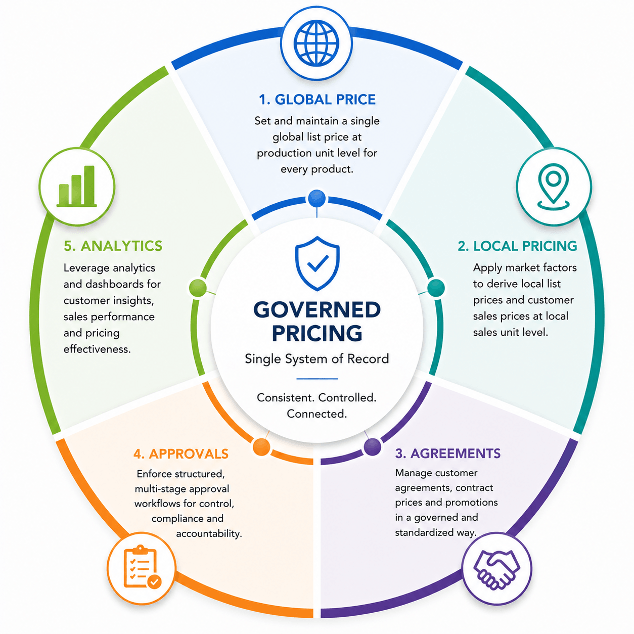
Solution Components
- Global List Price on the price list module - A global list price is now defined and maintained at production-unit level, giving the division one authoritative reference price for every product in the portfolio.
- Local pricing through agreements - Local list price and customer sales price are managed at local sales unit level in the agreements and promotions module, replacing the spreadsheets that previously held all agreement data.
- Market-factor pricing model configured - Each local sales unit's market factor was configured within the platform, so country-level sales prices are now derived systematically from the global list price rather than calculated offline.
- Real-time quotation pricing - The platform responds to pricing calls from the division's product configurator as sales users build a quote, returning prices for the selected base product and options in real time.
- Governed approval workflows - Agreement creation, submission, and approval were moved into structured platform workflows, removing the sequential manual approval chain that had slowed every deal.
- Analytics module for customer and sales insight - Analytics was implemented to give the division visibility into customer buying behaviour and sales performance as a standing capability rather than a periodic exercise.
- 19 dashboards delivered - Four dashboards were custom-built for the division alongside 15 standard dashboards from the partner's sales insight and customer insight accelerator package.
- Phased rollout design - The solution was built to scale from the two pilot countries to all local sales units, and from the low-voltage product line to the division's remaining product lines.
Integration Architecture
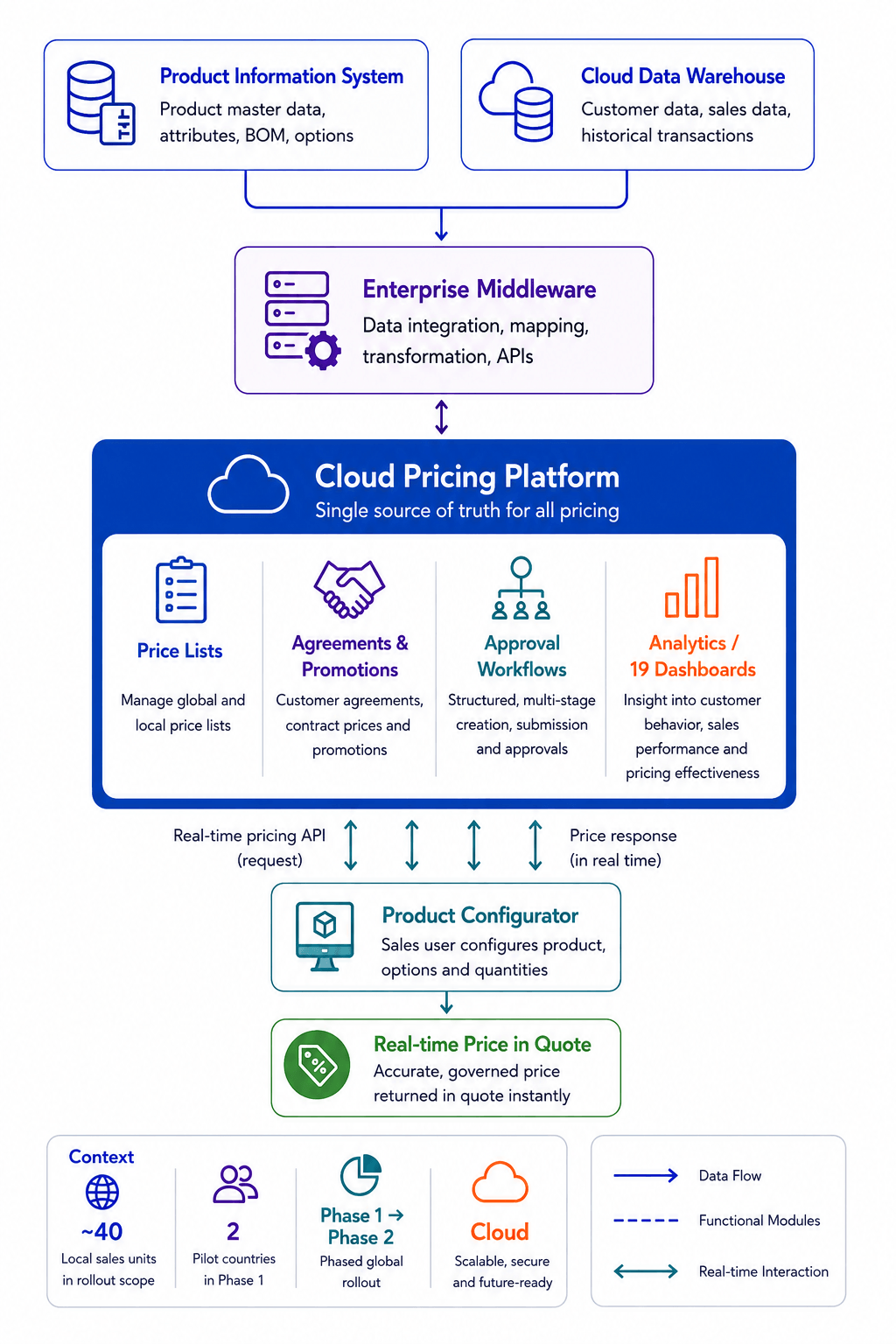
The pricing platform operates as the pricing back end for the division's quoting process rather than as a user-facing tool.
- Inbound - Product data is sourced from the division's product information management system and customer and transaction data from its cloud data warehouse, onboarded into the pricing platform through an enterprise middleware layer.
- Outbound - When a sales user configures a base product and its options in the quoting configurator, the resulting basket is sent to the pricing platform as an API request, and priced values are returned to the quote in real time.
Aligning the middleware and data-source development timelines with the pricing project timeline proved to be the most demanding part of delivery; the remaining middleware work is being completed as part of phase two.
Industry
Electrical and electronics manufacturing (global)
Geography
Production and sales operations across Asia, Europe, and North America
Scale
Approximately 40 local sales units in the rollout scope, with two pilot countries live in the first phase
Solution
Cloud pricing platform covering price setting, agreements, and analytics, with real-time quotation pricing and 19 dashboards
Major Benefits Realised
- Single governed system of record - Pricing and agreement data for the division now sit in one scalable cloud platform, replacing spreadsheet-based processes entirely.
- The client's pricing model natively supported - Global list price, local list price, and sales price are each maintained at the right organisational level, with market factors applied inside the system.
- Pricing available at the point of quotation - Sales users receive prices as they configure a product, rather than waiting on a separate pricing step outside the quoting process.
- Faster, structured approvals - Manual, multi-phase approval chains have been replaced by configured platform workflows, shortening the path from agreement to closed deal.
- Pricing insight for the first time - Customer and sales dashboards give leadership structured analytics where previously no systematic view of pricing performance existed.
- A repeatable rollout template - The pilot delivery established a pattern the division can reuse as it extends the platform to its remaining sales units and product lines.
- Ongoing partnership - The relationship continues into a phase two covering additional countries, further product lines, completion of the middleware integration, and a possible move into price optimisation.
Key Metrics