


Global Manufacturer Builds a Centralised Pricing Foundation
Overview
The client is a global manufacturer of industrial equipment and spare parts, operating across the UK and multiple European markets. While the organisation stored its data in a central ERP system, that system was used as a record store rather than as an active pricing tool - the actual pricing work happened in spreadsheets.
Each pricing manager maintained their own spreadsheet templates and formulas, held locally and shared by email. The organisation set out to replace this fragmented approach with a single, governed cloud pricing platform that every pricing manager could log into to set and publish prices consistently.
Key Challenges
- No centralised pricing system - Each pricing manager worked from their own spreadsheet templates and formulas; the ERP stored the data but was never used as an active pricing tool.
- Decentralised, inconsistent process - Different countries used different calculation styles, making it difficult to compare or validate pricing decisions at any level.
- Limited automation - Pricing was done manually and largely once a year, with no mechanism to receive overnight cost updates and generate revised prices automatically.
- No pricing visibility or analytics - Teams had no structured way to evaluate whether pricing was delivering value or how customers were performing commercially.
- Parallel ERP transformation - A major ERP modernisation was running at the same time, so the underlying data structures were evolving throughout the project, creating integration dependencies that had to be managed carefully.
Solution
Because the client had no existing centralised pricing tool, the engagement was effectively a build from the ground up — starting with alignment, then configuration, then integration.
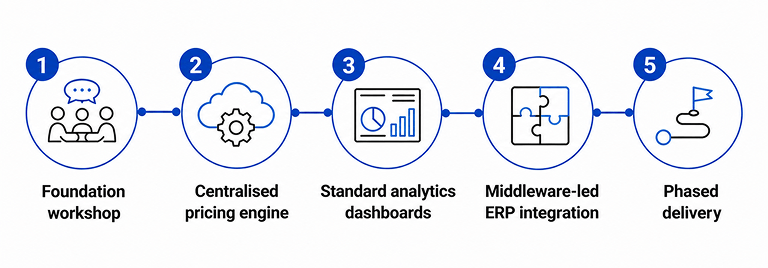
- Foundation workshop - A cross-functional foundation workshop was run with pricing managers from the UK and European offices, aligning all stakeholders on a common future-state pricing process before implementation began.
- Centralised pricing engine - The cloud platform's price setting and publishing capability was configured as the central pricing environment, enabling every pricing manager to log into one platform, set prices consistently, and publish automatically.
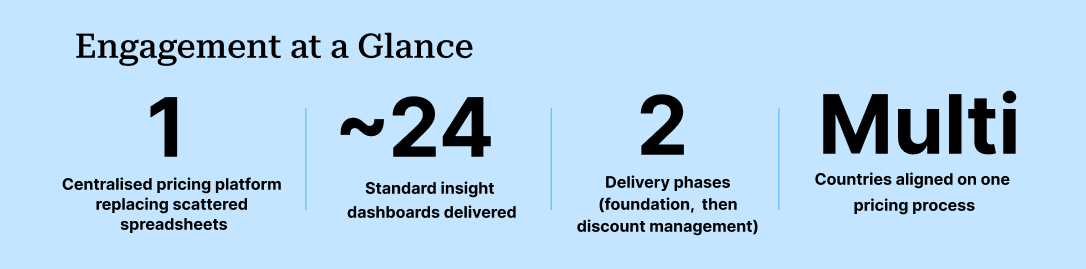
- Standard analytics dashboards - Around two dozen pre-packaged sales-insight and customer-insight dashboards were delivered with light customisation, giving the organisation commercial visibility for the first time.
- Middleware-led ERP integration - Rather than connecting the pricing platform directly to each individual system, integration was designed through the client's middleware layer. This gives the client full control over system changes during their ERP transformation, without requiring repeated changes on the pricing-platform side.
- Phased delivery - Phase 1 covered price setting, publishing, analytics, and integration. A later phase will introduce structured discount management (agreements & promotions) on top of the centralised list-price layer established in Phase 1.
Industry
Industrial equipment & spare parts manufacturing (global)
Geography
Multi-country operation across the UK and several European markets
Challenge
No centralised pricing system; each pricing
manager worked from individual
spreadsheets, with no common process or
visibility
Solution
Cloud pricing platform configured as the centralised pricing engine, with a jointly agreed pricing process, standard analytics dashboards, and middleware-based ERP integration
Module
Price setting & publishing, analytics, integration (with agreements & promotions planned for a later phase)
Engagement Status
This is an active, phased engagement. The majority of Phase 1 scope has been built and demonstrated, with the platform configured and the analytics dashboards delivered. Final integration and go-live depend in part on the client's parallel ERP transformation; go-live for Phase 1 is expected later in 2026, with a subsequent phase to follow focused on discount and agreement management.
Expected Benefits
On completion, the solution is designed to deliver:
- A single, governed pricing foundation - All pricing managers aligned on one shared platform and one agreed process, replacing isolated individual spreadsheets.
- A common, standardised pricing process - Conflicting country-level methods resolved into one governed approach through structured foundation workshops.
- Commercial visibility for the first time - Standard sales-insight and customer-insight dashboards giving leadership and pricing teams a unified view.
- An automation foundation - The basis to support overnight cost updates and automated repricing, replacing manual annual repricing cycles once the solution goes live.
- Future discount management - A planned later phase to introduce structured agreements and promotions on top of the centralised list-price layer.